Showing posts with label reviews. Show all posts

Monday, July 1, 2019

Banzhang Chun Qing - 10 years old - Revisited

Hi Tea Friends!

For 15 years I've been a puer tea collector. 

My puer collection lives behind this curtain in the corner of my office where it stays dark, dry and shielded from kitchen smells.


Peek-a-boo!

10 years ago I purchased one of Yunnan Sourcing's Banzhang Chun Qing Puer Tea Cakes (班章純情普洱茶餅) This tea was pretty hot on the 2009 tea blogger scene for good reason. It is delicious. For a little background on the cake and my original impression you can check out this old post.

On June 15th, I randomly grabbed this Banzhang Chun Qing cake when I had some friends over for a party. When I looked at the production date I smiled! The tea I had chosen to brew was very close to being exactly 10 years old!


♪♫♪♫ Happy Birthday to You ♪♫♪♫

I've enjoyed three sessions with this cake over the last couple weeks. When I posted a pic on my Instagram (brett_uke), the venerable Geoffrey Norman, suggested I write a follow up comparing the ten year old cake with it's younger self. Today I did just that! 

I used my white ceramic gaiwan and a 5 gram chunk of tea cake. This tea is sweet and fruity with peach aroma in some early infusions transforming into a musky ripe papaya. It has nice cinnamon, cedar and camphor notes in the back of my throat.

~5 gram chunk

The color is a few shades darker orange than it was 10 years ago. The liquor pours thick and brothy. I can't remember if it had this level of saponic thickness 10 years ago but it sure is satisfying today.

Earthier flavors and some sweet raisiny notes come to me after infusion #4. Mostly, the tea is all about the stone fruits and totally not smoky. Sometimes it reminds me of first flush Darjeeling.

Looking back on my decade old post I'd say this tea is aging just fine. It is a bit smoother, mellower and older tasting. I'm lucky to still have about half the cake left so I can brew it again in another decade!

3rd infusion

Any of you other old school tea bloggers out there still have any of this cake left? If you do, let me know! I'd love to hear how yours is aging! This tea has slightly renewed my enthusiasm for puer tea! 

Thursday, January 10, 2019

Cupping Two Winter Wenshan Baozhong Teas

Hi Tea Friends! Happy New Year! Long time no see!

I've been doing well. These days I stay busy taking care of my home and family, playing ukulele and guitar, cooking at a busy neighborhood vegetarian cafe, and drinking lots of great tea. I mostly drink oolongs and black/reds, but I'll happily drink some green tea or puer in social settings.

My tea blogging goal for 2019 is a minimum 300% increase in posts compared to 2018. That should not be too hard because I only had one post in 2018! Hashtag "setting the bar low" am I right ?!

Today I cupped up a couple of fresh, high quality, Winter Wenshan Baozhong teas (文山包種茶) from my friend's farm in Pinglin, Taiwan! (Check out my previous post for a photo of my daughter looking out at the very tea bushes these teas were picked from!)

-I'll call them Tea #1 and Tea #2.
-Tea #2 is about 25% more expensive than tea #1.
-Both teas were made by @Pinglin54 in November 2018.
-For each tea I used 4 grams of dry leaf in identical ceramic bowls.
-Water at about 200° F.

Ah! I love that sweet Baozhong fragrance!!! 

Tea #1

... and Tea #2
(I realize they both look pretty much exactly the same :)

Let me just start by singing ♪♫♬♪♫♬ I LOVE WINTER BAOZHONG! ♪♫♬♪♫♬

Both of these teas are superb but they did cup up very differently for me today.

Tea #1 had a grassier, thinner liquor. It was refreshing and crisp with a pleasant honeydew melon aroma, and pine-forest flavor notes. The body was good compared with most Baozhong teas, especially most Spring Baozhong, but it lacked mouthfeel and body compared with #1. It did win for throat-feel though. It left a really wonderful, peppery, sparkly aftertaste in the back of my throat that I didn't get much from #2.

Tea #2, as I just mentioned, was tops for mouthfeel! It was very thick and buttery and much more floral than its less expensive sibling. #2 was also more fragrant off the spoon too. I enjoyed its alluring flavor notes of lilac and mock orange.

In my happy place!

Monday, September 19, 2016

Bitter Melon Tie Guanyin - 苦瓜鐵觀音

Several months ago while drinking tea with my friends Jason and Andrew at Smacha, I received (among other things) a little sample of Bitter Melon Tie Guanyin (苦瓜 鐵觀音) oolong tea.

These days I typically choose either an oolong or a hongcha for my daily brew, and I tend to stick with teas I know. But today I was feeling more adventurous so I decided to give this novelty a try.

I was surprised to find the tea leaves are actually packed into a dried bitter-melon rind shaped like a little bumpy cylinder! The leaves themselves look and smell pleasant. It is a roasted oolong tea.


I used freshly boiled water and gave the "unit" a three second rinse in my gaiwan. It smells quite good, roasty, sweet and mellow.

The first infusion was about 30 seconds and poured pretty light. As you might imagine it took the water a few infusions to get into the center of this "wheel of leaves" and start to push the real flavor out. I continued to do short steeps because I was afraid of the bitterness that actually never came. After the second infusion, with the leaves pushing their way out of the melon rind, the liquor turned a medium-dark amber color. I enjoyed the flavor but it does have a weird vegetable note. The sweet caramel-like oolong flavors are muddied up by a tart cucumber-skin aftertaste. 


After 15 years as a heavy tea drinker I have a pretty good understanding of what my body craves. I drink tea for the satisfied feeling it gives me, the flavor, and the energy (qi) (). Maybe it's because I do not have any sentimental connections to bitter melon or it's potential health benefits that I found that this tea was ultimately not worth my time.

Monday, January 11, 2016

New Winter Baozhong!

Last week I treated myself to a couple ounces of Winter 2015 Wenshan Baozhong (文山包種茶) tea from Phoenix Tea in Burien, Washington. Today I'm trying it for the first time.

Beautiful, fragrant dry leaves.

For this session I used ~7 grams of dry leaf in my 100 ml gaiwan and freshly boiled spring water. Water was full boil (or very close to it).

You know how sometimes a cup of very fresh tea seems to sparkle with all those essential oils floating on the surface? This tea has lots of that, which I love!
 

The mouth-feel is thick and amazing. I can feel the tea coating my tongue and lips. The fragrance notes are: blossom, awesome, yum, and plum. My tasting notes are: clean, green, and nectarine. When the winter days are particularly dark and drizzly this tea will bring me a lot of good cheer. 

Thursday, April 30, 2015

Mauna Kea Tea's 2015 Green Tea

Last week I received a half ounce of fresh green tea from Mauna Kea Tea Company on the big island of Hawaii! Since my first post about this wonderful family farm five years ago, I've only tasted their teas a couple times, but I often think about them and enjoy following them on facebook and reading about Hawaiian tea production on their blog. Today I will share my review of their new 2015 Premium First Flush Green Tea.

The dry leaf of this green tea is really beautiful. It is made up entirely of long, twisted, leaf-and-bud sets with flecks of jade green, forest green, and silver. It smells fresh and sweet. A nice toasty aroma remains from the pan firing. 


For this cupping I used a large pinch of dry leaf, 165º F spring water, and a 1 minute steep in my glass gaiwan (steep time increased slightly with later infusions). The tea liquor is pineapple-yellow with a thick body and grassy fragrance.


I poured eight awesome infusions of this green tea. My notes bounced all around including herbaceous, floral, buttery and vegetal notes. This is my kind of green tea, it's complex and refreshing with a smooth and substantial mouth-feel. If you've never tasted Hawaiian grown tea I can think of no better place to start than this green from Mauna Kea Tea company.   

Thursday, October 17, 2013

Yixing Ming Cha

Recently my family and I visited my wife's aunt Mel. Mel is a wonderful person, an incredible chef, and a connoisseur of spices and coffee.

One afternoon, Mel showed me a pretty tin of Chinese tea that a friend had given to her. She had no idea what kind of tea it was or how best to prepare it. She had tried several times to enjoy it but unfortunately she was never able to brew it well.

I recognized the four Chinese characters displayed on both sides of the tin. They said Yixing Ming Cha (宜興茗茶) which I translated as "young and tender tea leaves from Yixing." A close inspection of the dry leaf indicated to me that this is a green tea with lots of fuzzy silvery buds. It looked like it was already a year or two old but the combination of a foil bag packed inside of a tin seemed to have benefited the leaves as they still had a nice aroma. I told Mel what I knew about Yixing, and their famous clay teapots, but I admitted that I didn't know too much about teas from this area.

The dry leaf.

I made a noble effort to brew the tea using Mel's six cup stoneware teapot and tap water boiled in a sauce pan (we couldn't find her tea kettle). Mel, my wife, and I all tried a mug and agreed that it was flat, boring, and grassy. When I suggested that this tea might taste much better if it was brewed in a gaiwan using spring water Mel gave me the tea.

Today I'm giving this Yixing Ming Cha my full attention. I used fresh spring water at 170° F, one rounded teaspoon of dry leaf, and a small gaiwan. My first infusion was ~1 minute.


Turns out this is a good tea although it is getting stale. It was probably picked in the early spring of 2012. The liquor is light with medium body. It is not at all nutty or roasty but it's a little bit sweet with a clean aftertaste. During four satisfying infusions I got some subtle notes of honeydew melon and a brightness in my throat that reminded me of decent white tea.

This session inspires me to keep a look out for Yixing tea in the future. Have you had any experiences with, or do you have any more information to share about, teas from this fascinating part of China? Also, what is the difference, if there is one, between Yixing (宜興) and Yang Xian (陽羡)?

Monday, March 11, 2013

2007 Hengfu Sheng Puer Cake

From 2005 to 2007, I (along with many other people around the world) spent a lot of free time buying, drinking, and studying puer tea. It was during these "bubble years" that I purchased most of my puer tea collection. I wouldn't say it's a huge collection. When compared to some other puer buffs I've met, it is really quite small. My collection currently hovers around 50 different teas, most of which are compressed (cakes, bricks etc.). During the past 5 years, I've reviewed nearly all of my puer teas on this blog.

One of the few tea cakes that I've yet to review is a 2007 Hengfu (恒福) sheng puer purchased from Seattle's venerable New Century Tea Gallery. I'll admit that I paid way too much money for this tea and the blame for that fact lies solely with me. It was a time in my life when I had some disposable income and I was trying to impress a friend, as well as the wonderful owners of New Century. As it turns out, vanity such as I displayed that afternoon, is NOT a good excuse for buying tea (or anything else for that matter). This realization, along with familial budgetary necessities, and other evolving personal interests, led me to a self-imposed ban on buying puer tea in 2010. (But I still trade for it and I love to get it as gifts!)

Anyway, back to the review... I'll begin with a lumpy photo of the wrapper. It has a big yellow diamond sticker covering the front which I've always thought was a little weird.


The dry leaves are flecked with brown and silver and have a pungent forest and smoke aroma.


Brewed in a small gaiwan with ~5 grams of dry leaf and freshly boiled water, this tea produced a medium-dark amber color with subtle camphor, cedar and tangy peach skin aromas. The flavor is too woodsy and grassy, dominated by oak, fresh hay, and sweet dry tobacco notes. Thankfully, it's not very smoky, but all of its nice aromas get lost in the grass. Also, the body is not as thick as I would like from a tea of this age. Infusion after infusion yields a smooth-ish, mild-flavored liquor with very little aftertaste. It's not bad but it's definitely nothing to write home about.


Saturday, January 26, 2013

Alishan Gift

My friend's parents recently returned from Taiwan and... lucky me... I scored some Alishan High Mountain Tea (阿里山高山茶) as a belated Christmas present!

The gift came in a red and gold bag with a beautiful crane and white flowers printed on it. The Chinese words on the bag claim this tea is: "Gold Ranking Collectable Tea" (黃金般的茶臻藏) and "Emperor Worthy Tea" (皇帝般的茶饗). The brand appears to be "金藏茶宴."

Lets see if the contents are truly "Emperor Worthy!"

The dry leaves look and smell amazing. They are large, loosely rolled, and possessing of fat long stems. My mouth begins to water.


This is an incredible tea in my opinion. The flavor transports me right back to Alishan. The tea soup is so fragrant with notes of orange zest, honeysuckle and cinnamon bark. The mouth-feel is thick with delightful syrupy and sparkly elements. The tea continued its greatness throughout 12 infusions and the aftertaste was clean, brisk and long-lasting. The spent leaves and thick soft stems radiate health and vitality. The tea left me feeling alert, creative and comfortable. Ahh. There can be no doubt I love good high mountain oolong. 謝謝 Janice and Mo!

Friday, January 25, 2013

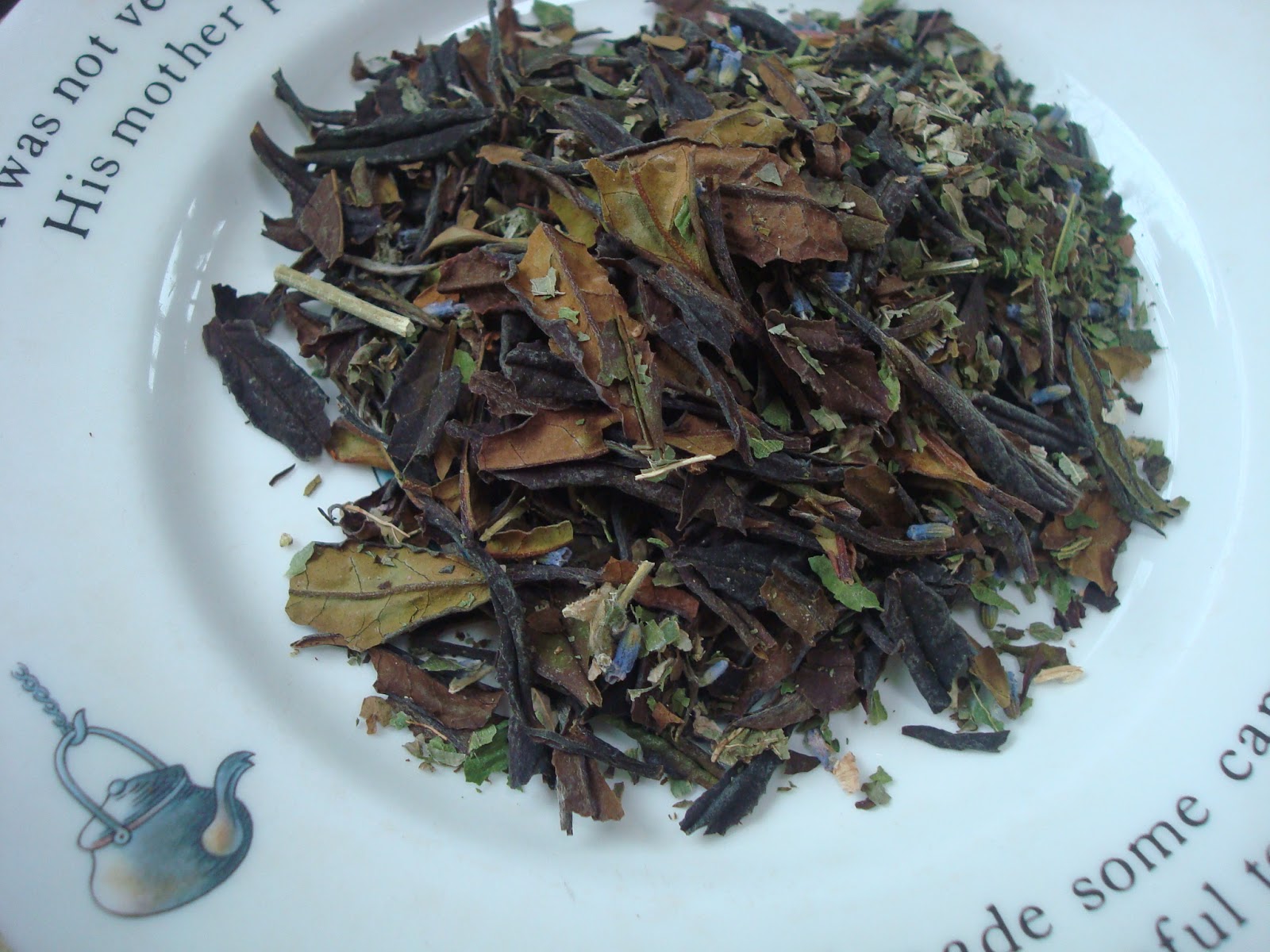
Northwest White Tea & Herb Blend

Seattle based, PCC Natural Markets, Portland based The Jasmine Pearl, and Sakuma Brothers Farm recently teamed up to offer PCC customers unique herb and tea blends made entirely out of local ingredients. PCC broke this news to their members last month with an article called "taken with tea."

This morning, while browsing the bulk teas at PCC, I saw these new blends for sale and decided to purchase a small amount to review here on my tea blog. I went with the white tea based blend which also contains blackberry leaf, nettle, lemon balm and lavender.


The dry leaf smells like lavender with some sweet grass, and wood notes. I used a heaping teaspoon of dry leaf, 8 ounces of 180° F water, and a medium Finum basket to infuse this blend. The resulting liquor was orange and fragrant. 

I love supporting local food and herb producers and I've enjoyed my past encounters with Sakuma's unmixed tea but this blend is not for me. The tea feels healthy and restorative to drink but it is too sweet and I really do not like the lavender flavor.

As an enthusiastic drinker of pure tea, perhaps I was never the target demographic for this product. I would be much happier to just see unadulterated Sakuma Brother's tea leaves on sale at PCC. That said, I'm sure many folks will think this blend has a great flavor and hopefully these products are finding fans among PCC shoppers. The quality of the ingredients and the wonderful people behind their production and blending makes them a good way to "drink local."

Tuesday, January 1, 2013

Māmaki

Māmaki is a small tree in the nettle family endemic to Hawaii. Native Hawaiians have used the plant's leaves and fruits as food and medicine for hundreds of years. The bark is also used to make cloth and rope.

For Christmas, my mother-in-law gave me a 0.55 ounce bag of dried māmaki leaves for use as a tisane. The recommended parameters printed on the package are: "Steep 1 teaspoon (1 - 2 leaves) in a cup of boiled water for 5 minutes, strain and resteep up to 3 times." I selected two large leaves and did just that.

The Packaging

The Product

The Liquor

This herb has a unique flavor. It is earthy, citrusy and grassy. I pick up notes of dandelions, rich black soil, bancha green tea, and metallic canned green beans. The aftertaste is where most of the citrus flavors linger. It almost reminded me of a somewhat earthy and musty Alishan high mountain oolong. Not bad.

Friday, November 16, 2012

Herbal Blends from Birds Eye Tea

Recently I received an email from Birds Eye Tea company asking if I'd be willing to review some of their products on my blog. I get similar emails fairly often but in the past I have always declined. Not this time though. I was intrigued, which was strange because they are an herbal tea company and my focus has always been on traditional tea made from the tea plant. That being said, I am interested in herbal beverages. Beyond the culinary realm, I really don't know much about plants and their many uses but I have been on a recent quest to learn more so Bird Eye's solicitation came at a good time for me.

After reading the email, I did some online research to see if I really wanted to review this company's blends. The first three things that attracted me to Birds Eye Tea were their logo, website and blog. The artwork has a smart, natural, d.i.y. feeling that appeals to me and their little bird logo makes me smile. From the blog, I learned that the proprietress, Sarah Farr, is a local Seattle herbalist who is extremely knowledgeable about plants. She uses both local ingredients (sometimes even forages for wild herbs herself) as well as more exotic ingredients such as Chinese herbs, real tea, and chocolate. I also like Birds Eye's business model which currently utilizes farmers markets, tasting events, etsy and a monthly subscription service to generate sales. Businesses such as this are almost always true labors-of-love and deserving of growth. For these reasons I agreed to review some of their blends.

One week later a box of goodness arrived at my house.


The box contained five blends and a tiny jar of DELICIOUS chai spiced honey. I've now tried all of the blends and offer the following humble reviews:

Floral Focus (Lightly oxidized Taiwanese oolong + Codonopsis + Osmanthus flowers)
The oolong tea base is actually high quality stuff. It's almost a shame to see it blended with the other ingredients. Fortunately its buttery, floral, refreshing goodness really shines through. The codonopsis adds a little earthiness to the flavor. I like!

Honeybush Spice (Honeybush + Cinnamon + Star Anis + Ginger + Cardamom + Orange zest + Licorice)
This blend is great. It was fine on its own but I'd probably only ever drink it with some soymilk and a touch of sweetener on a cold evening.

Slumbering Slope (Chamomile + Skullcap + Catnip + Spearmint + Rose + Licorice)
Sweet with fruity and grassy notes. Hippy bedtime tea. I like it. 

Awake (Yerba Mate + Tulsi + Bacopa + Spearmint + Currant)
Earthy and minty with a taste that reminded me somewhat of a chewable multi-vitamin. Not bad.

Xocolatl (Raw Cacao + Rose Petal + Chamomile + Spearmint + Ginger + Cinnamon + Star Anise + Chipotle powder + Roasted Cacao Nibs)
Yum! I liked this both straight and with soymilk and sweetener. The heat and spice from the ginger and chipotle are just right. Of the five, I see myself finishing this sample the fastest.

If you're into drinking herbal beverages or looking for a gift for a friend or family member who is, I would definitely recommend checking out Bird's Eye Tea.

Friday, October 12, 2012

2005 Tian Yi Sheng Puer Cake

This 2005 sheng puer tea cake boldly states "Yunnan tall tree old tea seven sons cake" (雲南喬木古茶七子餅). The middle of the cake advertises "Jinggu old tea" (景邁古茶), and the bottom says "Simao City Tianyi Puer Tea Factory produce" (思茅市天乙普洱茶廠出品).

The cake has been resting on my sheng puer storage shelf since I purchased it in 2006. I'm tasting and reviewing it today for the first time. To the best of my knowledge, I've never tried any other teas from Tianyi factory before.


The dry leaf looks dark and pretty. It has a sweet earthy smell like crispy Autumn leaves. I'm excited that this tea may be starting to deliver some complex aged-tea flavors.


Brewed in a medium size gaiwan with water just below the boil, this tea proved delicious indeed. It produced numerous deep amber cups with thick syrupy mouth-feel and many strong bubbles. It had woodsy pine-needle aroma.

This is a fine cake of puer tea in my opinion and a great accompaniment to a cool, cloudy, misty Seattle Autumn day. It combines subtle old wild forest notes with savory, herbaceous, sheng puer flavors. Ten infusions left me feeling comfortable, relaxed and alert.

Tuesday, October 2, 2012

2013 Tea Calendar

A few days ago, I received a beautiful 2013 tea calendar put together by the esteemed tea writer and photographer Lindsey Goodwin. I first saw it advertised on our mutual friend Steph's tea blog and after checking it out on Lindsey's Copy and Taste Blog I knew I needed one.


This calendar is unique in that it features many major and minor holidays from all over the world. That alone would have been enough for me... but Lindsey's calendar goes much further by including lots of tea-related dates every month. For example, February 4th is the Chanoyu Celebration of Dawn in Winter, and April 18th kicks off the Shanghai International Tea Culture Festival. Who knew?! Another cool thing about this calendar is that every month features a recommended tea. I'm going to make a point of drinking at least one cup of these recommended teas throughout 2013!

Friday, September 14, 2012

Golden Peacock Shu Puer Cake

A tea lover named Richard recently returned from China with a tong (筒) (or possibly more) of these shu puer tea cakes. Nearly two weeks ago he sent me a generous half-cake sample to evaluate. 謝謝 Richard!

The cakes are labeled Menghai seven sons cake tea (勐海七子餅茶) across the top and Li Ming Xing Huo Tea Factory (黎明星火茶厂) across the bottom. In the middle is a painting of two lovely peacocks and a sign that says Golden Peacock First Class Cake (金孔雀一級餅). The wrapper is stamped with a May 2007 production date. I also found these cakes here on Tao Bao.


The dry leaf has a pretty appearance, mixing rusty-red and golden-brown flecks with dark brown leaves. It has a woody, nutty aroma.


I've had a few sessions with this tea now and I like it quite a bit. It is easy to pour dark and smooth. There was a little bit of an acidic finish on some infusions but most were sweet and milky. It's not terribly complex but it goes the distance and it doesn't have any unforgivable faults in my opinion. Later infusions, when the tea soup starts to lighten up in color, are wonderfully sweet and even display fruit and honey notes that remind me of ripe plums. When the liquor got cold in my cup it yielded some great vanilla bean notes too.

Richard reported "a highly caffeinated" sensation after drinking this cake but my sessions with it have left me feeling relaxed (almost sleepy), mellow, and thoughtful. That is my most common physical reaction after drinking a large amount of decent shu puer.


Sunday, September 2, 2012

Sakuma Brother's Washington State Oolong

The Sakuma Brothers farm in Skagit County, Washington State has been growing tasty berries for over 85 years. I first heard about their tea growing experiments about 6 years ago when a coworker at the Teacup purchased a small bag of their white tea at a farm stand. At this time, the idea of growing tea plants in Western Washington was entirely new to me and I was excited to taste the tea. My impression of that tea was poor. It looked and smelled pretty good but the flavor was lack-luster and tasted strongly of raspberries.

Until just 2 days ago, I had not tasted any other tea from the Sakuma Brothers farm but I still tried to keep their operation on my tea-dar. I met Richard Sakuma at World Tea Expo and I could tell that he is a true tea lover and eager to grow and process high quality tea. A year or two later, I heard that Sakuma's tea making skills were getting much better thanks to practice, study and joining a Taiwan tea tour with Floating Leaves. Last week my desire to taste their tea again got the better of me and I ordered a bag of their current Oolong offering.

The dry leaves are brown and green with flecks of silver. They have a mild aroma that reminds me of fresh hot soy milk.


The tea pours a sunny yellow liquor with a fragrance of oranges and hay.


The mouth-feel is light and fleeting with a sparkly texture and the flavor is very nice. It most certainly has berry notes but they are subtle. For me it tasted like a weak, floral, jade oolong brewed with a chunk of tart, unripe strawberry and possibly a leaf or two of rosemary. It is unlike any other tea I've ever had but I would call it complex, interesting and enjoyable. It doesn't have much of an aftertaste (which is, of course, preferable to a bad aftertaste). I would have to say that for the very new world of Washington State tea, this is the best one I've sampled so far. I find that to be very exciting and encouraging!

Tuesday, July 17, 2012

South Seattle Tea Estate - 2012 Harvest Report

As the manager of the South Seattle Tea Estate, I am saddened to inform you that 5-year-old "Leafer," our oldest tea plant, died over the winter. The 3 remaining plants looked scrubby and beaten at the start of spring. For this reason I decided not to make spring 2012 tea.

Summer has been good to our 3 tea plants and they are now, for the most part, looking healthy and producing new leaves.


On July 15, 2012, I decided to make an experimental summer oolong. The harvest took place at 9:00 am. Due to a dearth of tender leaf and bud sets I decided to pluck more mature, lower leaves. In all, I selected 28 leaves for a total of 15 grams. The leaves were arranged in a single layer in a glass baking dish for withering.


After about an hour and a half of withering in the shade the sun broke through the clouds. At this point I moved the dish to the roof of my car for some full-sun withering. The day became quite warm with a nice gentle breeze.


2:00 pm - The leaves were a little bit limp but some bits were too crispy for my liking. Also, some leaves appeared to be getting a "sun burn" so I decided to bring it inside.

3:15 pm - I spent 3 minutes shaking and kneading the leaves.

8:00 pm - I spent another 3 minutes kneading, twisting, shaking and bruising the leaves. I felt like the leaves were getting too dry and brittle so I mounded them up together and covered them with an upside down bowl.

The following morning (today) at 6:30 am - I checked the tea. It had a sweet tobacco-like aroma and a mottled brown and green coloring like camouflage. After ~3 minutes more rolling and kneading. I mounded up and recovered the limp leaves with the same bowl.

9:00 am - I did even more kneading and rolling and then took this photo after which the leaves were then left uncovered.


11:00 am - I baked the leaves for 30 minutes at 250° F in a cast-iron pan. The leaves were mainly in a single layer. I gave them a gentle stir about halfway through baking. The next picture is of my finished tea. It weighed about 5 grams.


I fired up the kettle and placed half of my total harvest into a small gaiwan. My first steep was boiling water for 3 minutes. The color was a lovely golden yellow and the liquor had a sweet smell with notes of raw pumpkin, cooked yam and unlit cigars.


I was trying to make a darker tea, but I was still pleased with the outcome of this experiment. The tea lacked for mouth-feel but it surprised me with complexity. The raw pumpkin aroma stuck with it through 3 infusions but the taste kept changing. It was always brighter and fruitier than I was expecting. I even picked up some guava and nectarine notes as well as a syrupy sweetness.

I'm glad I have enough leaf left over for one more session. I plan to bring it to Phoenix Tea this weekend to share with other tea lovers.

Friday, July 6, 2012

2010 Ban Pen Sheng Puer Cake

Today I'm reviewing Essence of Tea's 250 gram 2010 Ban Pen (班盆) sheng puer cake. This cake was one of several fine teas I received during my recent tea trade with Tea Sleuth. More information about Ban Pen can be found on Essence of Tea's blog here.


I steeped the tea with freshly boiled water in a small gaiwan about 1/3 full of loosely compressed dry leaf. After a 3 second rinse, I inhaled an inviting herbaceous aroma. The first couple infusion were about 20 seconds long.


I was very impressed with this lively young tea and its complexities demanded my full attention. The liquor is a bright yellow color with subtle cloudy currents circling about lazily among stationary bubbles. In the mouth it's dry with notes of sweet hay, leather and clove. It had a clean, brisk, invigorating, throat-feel. Its finest moments, for me, were when it presented some delicate wild flower honey and Meyer lemon notes.