Showing posts with label Wenshan Baozhong. Show all posts

Thursday, November 18, 2021

Gongfu Cha (工夫茶) Demonstration Video!

Hi Tea Friends! It's been a whole year since I popped into this space. I still drink lots of loose leaf tea but my main gig at this point in my life has been playing and teaching Ukulele and Guitar. My other passion these day is supporting my brilliant wife Alanna's emerging career as an Author!

Today I'm bringing you a video that combines my 3 passions! 

1. It's a Gongfu Cha demonstration video!

2.  It supports my wife's new book Within Every Flame!

3.  It features my original tune Tiger Relay! 

Within Every Flame is book 3 of her AMAZING Call of the Crow Quartet. If you've been "sleeping" on her first two books, When We Vanished (#1) and Where Shadows Grow (#2)... what are you waiting for!? These books are so so good. So good, that they make my heart ache... but in a good way somehow! :) All of Alanna's books are so rich with darkness, light, emotion, plot, intrigue, and many amazing characters. I've read them a few times now and each time I make new connections and discover fascinating new details. 


You can buy Alanna Peterson's printed books or ebooks from our indie publishing company Rootcity Press (US customers only) or order them from your favorite bookstore (available in many countries)! 

Thursday, January 10, 2019

Cupping Two Winter Wenshan Baozhong Teas

Hi Tea Friends! Happy New Year! Long time no see!

I've been doing well. These days I stay busy taking care of my home and family, playing ukulele and guitar, cooking at a busy neighborhood vegetarian cafe, and drinking lots of great tea. I mostly drink oolongs and black/reds, but I'll happily drink some green tea or puer in social settings.

My tea blogging goal for 2019 is a minimum 300% increase in posts compared to 2018. That should not be too hard because I only had one post in 2018! Hashtag "setting the bar low" am I right ?!

Today I cupped up a couple of fresh, high quality, Winter Wenshan Baozhong teas (文山包種茶) from my friend's farm in Pinglin, Taiwan! (Check out my previous post for a photo of my daughter looking out at the very tea bushes these teas were picked from!)

-I'll call them Tea #1 and Tea #2.
-Tea #2 is about 25% more expensive than tea #1.
-Both teas were made by @Pinglin54 in November 2018.
-For each tea I used 4 grams of dry leaf in identical ceramic bowls.
-Water at about 200° F.

Ah! I love that sweet Baozhong fragrance!!! 

Tea #1

... and Tea #2
(I realize they both look pretty much exactly the same :)

Let me just start by singing ♪♫♬♪♫♬ I LOVE WINTER BAOZHONG! ♪♫♬♪♫♬

Both of these teas are superb but they did cup up very differently for me today.

Tea #1 had a grassier, thinner liquor. It was refreshing and crisp with a pleasant honeydew melon aroma, and pine-forest flavor notes. The body was good compared with most Baozhong teas, especially most Spring Baozhong, but it lacked mouthfeel and body compared with #1. It did win for throat-feel though. It left a really wonderful, peppery, sparkly aftertaste in the back of my throat that I didn't get much from #2.

Tea #2, as I just mentioned, was tops for mouthfeel! It was very thick and buttery and much more floral than its less expensive sibling. #2 was also more fragrant off the spoon too. I enjoyed its alluring flavor notes of lilac and mock orange.

In my happy place!

Sunday, May 8, 2016

10 Years Ago Today

On May 8, 2006, during my second trip to Taiwan, my friend Shiuwen treated my buddy Darald and me to an unforgettable tea tour. We met up with her bright and early in Taipei and had a hearty breakfast of steamed vegetable buns, fried youtiao and fresh soymilk. After our meal, and after we took care of a few errands (including sending my mom a Mother's Day card), we proceeded via metro to Xindian station, which is where we got the bus up to Pinglin.

It was a very hot day in Taipei and the air was barely moving but once we got off the bus in Pinglin we were soothed by a lower temperature and a gentle breeze. The air in Pinglin is sweet and the surrounding hills are lush and green. Our first stop in town was Shiuwen's friend Farmer Chen's tea shop where we drank some unforgettable Wenshan Baozhong tea. After tea we had a satisfying lunch of tea oil noodles (a local specialty), fried tofu, and soup with lotus flowers.

After lunch, we headed up to Farmer Chen's tea farm by car. Once at the farm I was excited to learn that we would be able to pick tea leaves. Darald and I were shown the basic technique, given a hat and basket, and put to work. In one hour I had plucked less than one tenth of the tea the locals had harvested. I watched as their hands moved quickly and skillfully over the tea bushes while my hands brought to mind those of an intoxicated sloth. I was still given a pat on the back and told that I didn't do too bad for my first try. It was a wonderful experience that left me with even greater respect and appreciation for the professionals.


After tea picking time we spread our leaves on rattan trays to wither...


...then we walked over to the neighbor's farm to see Dong Fang Mei Ren (東方美人) oolong tea in various stages of production.


As we walked around the misty, green farms, Chen and Shiuwen pointed out the different cultivars of tea bushes we passed. Qing Xin (青心) was the most common, but Jin Xuan (金萱), Fo Shou (佛手) and even Wuyi Mountain Shui Xian (水仙) tea bushes were planted in this area.

(This one is Fo Shou.)

We drank some more fresh tea and then traveled back to town. Shiuwen, Darald and I visited a large facility for de-stemming and sorting hundreds of pounds of Wenshan Baozhong tea. It was fascinating.


We stopped into another tea shop where I purchased some baked Baozhong for Teacup (the store I was managing at the time), and two clay teapots (for myself). I also took a small shot of Baozhong wine offered to me by some locals. It was strong stuff.

In the evening we said goodbye to Pinglin and hopped aboard a bus headed back to Taipei. The ride was somewhat eventful because an air conditioning unit was leaking water all over one vinyl seat. About halfway to Taipei the bus was full except for that seat. An old lady came in with two plastic bags. She looked all around for a seat and was dismayed by her only option being soggy. I was close by so I sprung up to offer my seat. She tried to protest but I insisted and she sat down while I stood. Then she gave me a present. It was a special local food. Some type of gummy rice pocket with a bright, artificial-red, raw-onion-tasting filling. I thanked her and ate a little bit. I gave the old lady a smile and a big thumbs up... but I really didn't like it, so I put it in my pocket to deal with later.

The evening in Taipei was not too hot and we all had a great dinner at a Buddhist buffet. Then we headed over to Shiuwen's friend Lao Ji Zi's shop for even more great tea.

(That's our own fresh picked Baozhong leaves on the tray.)


Although we were already quite tea drunk we made room for some more amazing tea. I had an Alishan High Mountian Oolong that was so incredible. It was the type of tea that makes a tea-person empty out their wallet and say, "How much will this get me?"

We also cupped up the Baozhong leaves that we picked that afternoon. By this point they had only been withered slightly and jostled about in our bags during the commute back to town. They had a subtle sweet floral aroma and clean clear broth with notes of lilac and dew. A very refreshing way to end the night.

(Those are our jade green leaves in the large bowl.)


All in all it was a wonderful day in Northern Taiwan. I can never thank Shiuwen enough!

Monday, January 11, 2016

New Winter Baozhong!

Last week I treated myself to a couple ounces of Winter 2015 Wenshan Baozhong (文山包種茶) tea from Phoenix Tea in Burien, Washington. Today I'm trying it for the first time.

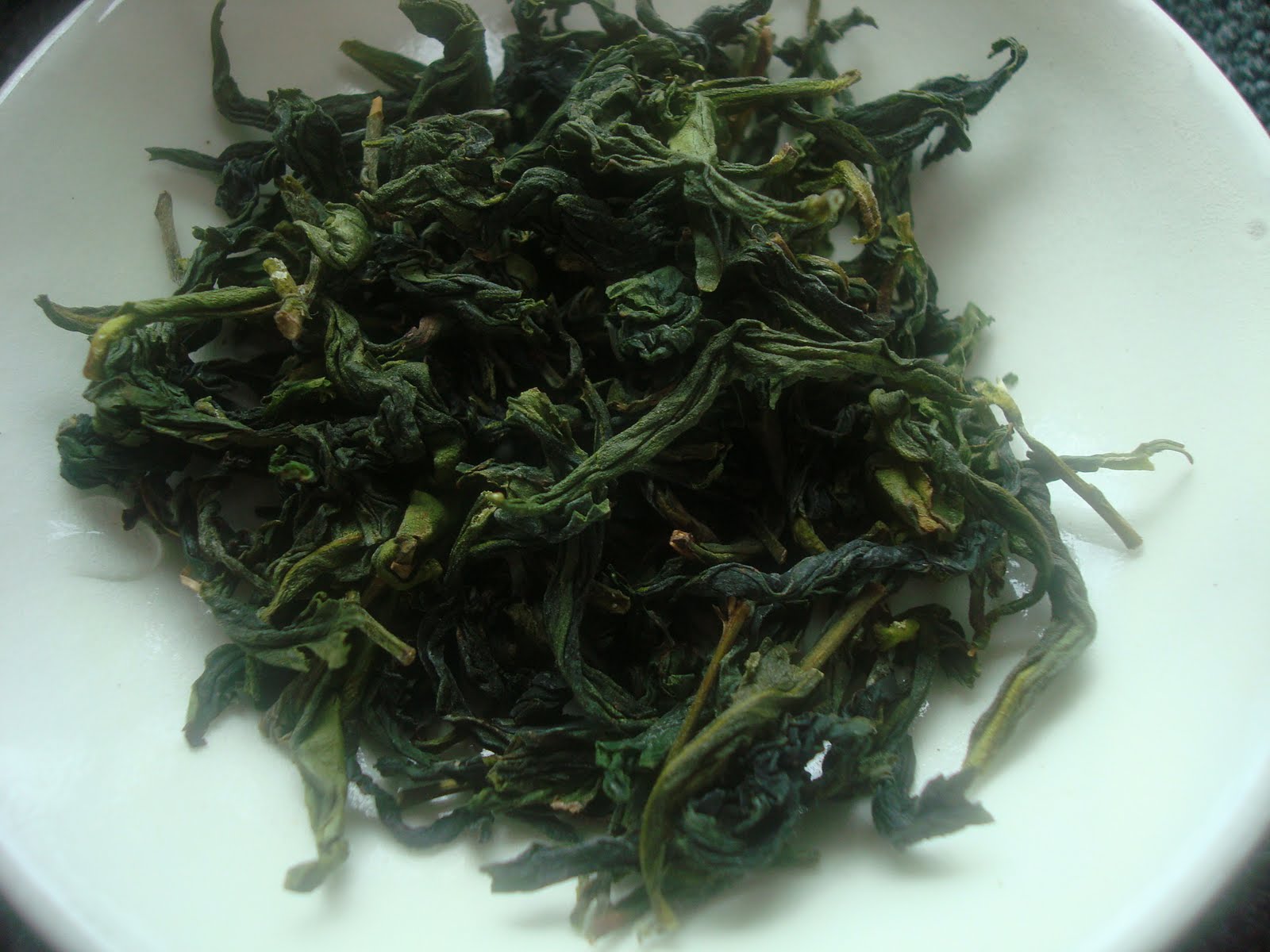
Beautiful, fragrant dry leaves.

For this session I used ~7 grams of dry leaf in my 100 ml gaiwan and freshly boiled spring water. Water was full boil (or very close to it).

You know how sometimes a cup of very fresh tea seems to sparkle with all those essential oils floating on the surface? This tea has lots of that, which I love!
 

The mouth-feel is thick and amazing. I can feel the tea coating my tongue and lips. The fragrance notes are: blossom, awesome, yum, and plum. My tasting notes are: clean, green, and nectarine. When the winter days are particularly dark and drizzly this tea will bring me a lot of good cheer. 

Friday, May 31, 2013

The Seasons of Baozhong

I fell in love with Wenshan Baozhong tea (文山包種茶) after my first sip back in 2001. Since that day I've tasted many grades of this tea from many wonderful tea sellers.

My wife and I visited Pinglin, Taiwan (坪林,台灣) in 2007 and ever since that trip most of the Wenshan Baozhong tea that I've sold has come from the same small farm near this lovely town.

One thing that all tea lovers learn, soon after we get "bit by the tea bug," is just how important seasonality is to our favorite beverage. Regularly drinking baozhong tea from the same farm while chronicling my sessions in a journal and on this blog have given me a few personal insights to share with you about the seasonality of Wenshan Baozhong tea.

Wenshan Baozhong tea from Pinglin is usually produced in the winter (actually it's more like November depending on the weather but they still call it winter tea) and in the spring (usually April but sometimes it can be March or May depending on the weather). Some Pinglin tea farmers also produce other styles of tea such as Dong Fang Mei Ren (東方美人). In my experience Dong Fang Mei Ren is usually made in the summer or fall.

Today I'm drinking the spring 2013 Wenshan Baozhong that arrived at Phoenix Tea nine days ago. It is very buttery and floral with great lilac and mock-orange blossom aromas. The mouth-feel is good and there is a delicate brothy sea-vegetable note in a few early infusions. It has a very clean finish and a soothing energy that several other folks have commented on after sharing a few cups with me.

'Tis the Nectar of the Gods!

This spring 2013 baozhong tea is livelier than last spring's but it is not as dynamic in regards to mouth-feel and lingering aftertaste as the winter tea has been these last few years. I used to think spring baozhong tea was always lighter and more floral and winter tea was always bolder and fruitier but I've come across too many exceptions to still hold this as truth. The last couple years the spring baozhong tea and winter baozhong tea from this farm have been equally floral but the winter tea remains bolder and delivers more lingering aftertaste.

Also, winter baozhong tea, in my experience, is easier to brew. Any ole way I prepare it, winter baozhong tea has always tasted great and the aftertaste has been incredible. Spring tea, on the other hand, demands that I slow down and take care to use fresh, not-over-boiled, spring water and a larger pinch of dry leaf. If I manage to get everything just right it will reward me with heavenly aroma and a pearly, slippery feeling on my lips... otherwise it will fall flat. When this happens, spring baozhong can be too boring for me. Fortunately, every cup I've made of this new 2013 batch at Phoenix Tea has really delivered the goods. I guess I actually love spring and winter baozhong for different reasons and despite all that I've just written I try not to dwell on past teas while drinking a new tea because it's not fair to the tea that's presently being sipped. 

It's possible that your own experiences tasting winter and spring Wenshan Baozhong tea may be different from my own... but whatever they may be, please take a minute to share them with a comment! 

Friday, May 11, 2012

2008 Wenshan Baozhong Roasting Experiment

Back in May of 2008 my little sister Nicole, her husband Justice, Justice's little sister, my friend David, his fiance Gwen and I all spent 8 awesome days together on a tea trek in Taiwan. During our trip, everyone purchased a good amount of fresh oolong to bring back home.

Last week, while spending some time in her sister-in-law's kitchen, Nicole discovered one unopened 300 gram bag of Wenshan Baozhong forgotten in a cupboard! Nicole and her sister-in-law were sad that it was never enjoyed and decided to send it to me for some comments on its current quality.

A few days later I held the neglected bag of tea in my own hands. The vacuum seal on the bag was broken and probably had been for years. The leaves themselves looked OK but they lacked aroma. I brewed a small amount in a gaiwan. It was flavorless and flat with only the tiniest hint of its original Baozhong fragrance. Worst of all was the aftertaste, which was bitter and harsh.

I decided to experiment with my Taiwanese electric basket-roaster (although my hopes were very low that the tea could be saved). I saved about an ounce of unroasted tea in a little tin and poured the rest (about 9.5 ounces) into the basket-roaster.

The basket-roaster (it has a lid) and the tea's original bag:


I baked the tea at Phoenix Tea for 2 hours at 100° C before stopping to mix gently. Towards the end of this period the store began to smell sweet. Then I raised the temperature to 130° C for 1 hour and mixed again. Finally I lowered the temperature back to 100° C for one more hour.

At this point the leaves (and the store) were smelling wonderful. The smell is hard to describe but it's a little bit like I was making candy and baking sugar cookies at the same time.

Unfortunately when I brewed the tea a few minutes later the flavor was still bad. It had a hint of warming roasty goodness but it was bland and the aftertaste was terrible. I decided to roast the tea longer the next morning.

The following morning I baked the tea for 1 hour at 100° C and then 2 hours at 130° C (mixing gently every hour). Once again the same heavenly aroma filled the air.

I estimated an equal pinch of leaf into two bowls and poured in freshly boiled spring water.

Roasted on the Left. Original on the Right.


Interestingly the Original tasted slightly better this morning. Most likely it benefited greatly from 24 hours spent outside of the bag it had been trapped in for 4 long years. It still lacked flavor but it yielded more floral aroma and had an improved aftertaste.

The Roasted tea was nuttier than it had been yesterday which for me was an improvement. Cinnabar, who joined me for this tasting but did not try it the day before, pointed out undesirable notes of cornflakes and straw. We both agreed that the tea was "not good" and had a weird aftertaste (sort of metallic tasting).

After the Roasted tea had cooled down I put it back inside its original bag, a step I now regret because I suspect the bag is partly to blame for the tea's bad aftertaste.

A week has now passed since this experiment began. Today I plan to throw away the original bag, roast the tea for a few more hours, and then store the tea in a special jar for a few weeks. After which I will write a follow up to this post.

Thursday, March 15, 2012

Cupping Experiment - Broken Baozhong Leaves

Have you ever notice how the last few grams of tea in any tin or bag is usually a sad-looking mix of broken, dusty tea-crumbs? In my experience this is especially true with long twisted leaf teas such as Wenshan Baozhong (文山包種) or various Wuyi Mountain Cliff Teas (武夷山岩茶).

Case in point:


What you're looking at here was poured from the bottom of an extremely good bag of Winter 2011 Wenshan Baozhong. This broken melange weighed in at just about 8 grams. What would you do with this stuff? Drink it? Toss it? Sift it?

I'm a pretty frugal fellow so I'll use a colander to gently separate the dust from the larger leaves.


This time I'm left with ~6 grams of dust and ~2 grams of whole leaves.


Feeling curious, I decided to conduct a little tasting experiment. I set up three small tea bowls. In one I put 1 gram of large leaves, in another I put 1 gram of broken leaf dust, and in the third I put a mix of 1/2 gram dust and 1/2 gram leaves. Next I steeped each sample for 3 minutes with 120 ml of 180° F water.

Mix is at the top.
Unbroken is in the bottom left.
Dust only is in the bottom right.


This cupping was interesting. Surprisingly, I found myself liking the dust-only infusion (shown above with the brightest yellow color) the most. It was just as buttery as the whole leaf specimen but it had better mouth-feel. It wasn't bitter but I expect it would have been if I'd used boiling hot water.

The infusion made only from intact leaves was the sweetest and the most floral. I liked it quite a bit too. I'm betting it would have otherwise been better than the dust-cup but in this particular instance it was "under-leafed."

The mix was easily the worst of the three. Instead of tasting like the sum of its parts, as I would have guessed, the 50/50 mix of dust and whole leaves came out flat and stale tasting. The balance was off and it was hard to find any redeeming qualities in the liquor.

Like all such casual cupping experiments these results don't really mean anything in the larger scheme of things. It was really just an interesting diversion. That being said, it does inspire me to sift the "bottom of the bag/tin" leaves and crumbs more often.

Wednesday, February 15, 2012

Great Wall of Baozhong

Entries in the Spring 2008 Wenshan Baozhong (文山包種) tea competition in Pinglin, Taiwan waiting for judgment day.


*Photograph by my friend David W.

Monday, November 7, 2011

Aged Wenshan Baozhong

I was lucky to visit Red Blossom tea company back in 2007. One of several treasures that I purchased during that trip was their Aged Wenshan Baozhong oolong tea. I was told that it was made in the "early 80's."


I was curious to know if they still had this exact tea in stock so I emailed their customer service department. I quickly received an informative response from Red Blossom's Peter Luong.

He wrote:

"When we made the original purchase of the 1980's Aged Wenshan, there were two distinct batches. They were similar age range and from the same source. The appearance of the leaves were slightly different but nearly identical in character/taste/aroma. I think we were working off the first batch when you made the original purchase, and have gone on to the second batch."

So it sounds like you can't actually buy this tea that I'm about to review. Oh well. I'm going to write about it anyway.

I filled my small gaiwan ~half-full of dry leaf and gave it a 3 second rinse with boiling water. The fragrance off these damp leaves was breathtaking. It smelled earthy and roasty with luscious brown sugar and raisin notes.

I was surprised by the dark color of the liquor. It looked a little bit like a cup of Da Hong Pao oolong.


The richness of this tea was deep and mystifying. As I sipped, I felt soothing energy spreading down through my shoulders, arms and hands. It presents subtle wine notes like oak, plum and blackberry along with fire notes such as wood and charcoal.

This tea is complex, full-bodied and slightly sweet. It is very much what I'm drawn to these days.

Wednesday, November 2, 2011

Cupping 2005 & 2006 Wenshan Baozhong

Six and a half years ago I set aside ~4 ounces of fresh spring 2005 Wenshan Baozhong (文山包種) tea in a tall mason jar with a screw on lid. One year later I did the same with my 2006 Wenshan Baozhong, but this time I used a shorter jar with a rubber gasket lid.

Since that time the leaves have been stored in the dark corner of a bookshelf, behind a curtain, along with my humble puer collection. I have only opened them once, a few years back, to take a little sniff.

Today will be the first time I've cupped them since they were new.

2006 (left) and 2005 (right)


I chose two identical glass mugs for this cupping. In each mug I used 2.5 grams of leaf and 80 ml of boiling water. I sipped directly from the mugs and added more water several times.


I realize that today's cupping will provide me with very little useful information. This is because I do not have any notes or memories (except the notion that they were once really good) about how these two teas originally tasted. So today I will just describe my impressions so that I'll have a useful "baseline" a few years later when I decide to repeat this cupping.

The dry leaves look similar but I noticed a few more woody stems in the 2005. The 2006, on the other hand, had a few more broken leaves. For both teas, the aroma off the dry leaves is muted and underwhelming. The 2005 reminds me a little bit of stale graham crackers and the 2006 reminds me of stale graham crackers in the grass.

The flavor of 2005 was slightly darker and earthier and its aroma was a bit mustier. It was still a little bit floral and had a nice thick mouth-feel. I also perceived a soft ocean flavor in this tea.

In contrast, the 2006 drank much more like a new tea. It had a delightful lilac aroma and a crisper medium-body with buttery notes. Perhaps the rubber gasket sealed in more freshness?

Both teas were long lasting and soaked for hours without bitterness. All in all I was pleasantly surprised by the taste of these two teas.

Although these two specimens are both spring Wenshan Baozhong teas from Pinglin, Taiwan they really have little else in common. They were made at different times by different people on different farms. But now they share the same fate. I'll now put them back in their little hide-away to await the next cupping.

Friday, June 24, 2011

Three Grades of Spring 2011 Baozhong Tea

Yesterday, I cupped three grades of Spring 2011 Wenshan Baozhong Tea (文山包種茶) produced by my buddy Amin (and his family) in Pinglin, Taiwan. If you read Chinese (unlike me) and/or if you'd like to see videos of Amin making tea with his family, here is the link to his blog.

For this post, I will call the teas C (lowest grade), B (middle grade) and A (highest grade). I've tasted A a few times already on its own and I really like it, but I've never tried B and C before this cupping. According to Amin, these teas were picked in mid-May using the qing xin (清心) tea plant (which is common in Pinglin for Baozhong tea), and pass SGS tests for pesticide residue.

I set up a "more casual than usual" cupping station and then measured out 5 grams of dry leaf for each tea. I used spring water at a full boil.

C (top left)
B (top right)
A (low middle)


I was very pleased that my tasting notes and Amin's descriptions were analogous. Not that I ever expected otherwise. He has earned my trust over these last 4 years by always selling me great tea at a fair price.

This was a very pleasant cupping indeed (wish you could have been here). The window was open and the cool misty morning breeze filled the house with delightful garden aromas. I poured into each cup and then just put my nose in real close. Ahh.

C was nice... but when it was compared to the other two teas it didn't stand a chance. It came across as grassy and bright with fleeting fragrance and weak body.

B was the creamiest. It also appeared to be a little heavier oxidation. Great texture, even a little bit better than A, but lacking for aroma. It had a nice ripe honeydew melon note.

A: This tea was the king for floral fragrance, yielding lots of sweet lilac and mock orange blossom notes. The liquor felt thick and buttery with many wonderful pine, fruit and herbal notes.

PS: I have about 12 ounces left of A and I'd really love to place it in good homes (for $10 per ounce). If you and your teapot (or gaiwan, I don't discriminate) are looking to adopt some Baozhong tea (or Spring 2011 Alishan Zhang Shu Hu for that matter), please email me at blackdragontea@gmail.com

Wednesday, March 2, 2011

2001

Exactly ten years ago (just days after the Nisqually earthquake) my then-girlfriend-now-wife Alanna and I loaded up our cars and headed north to Seattle. She was transferring to UW from UNR and I was excited about landing a vegetarian cooking job and making music in one of my favorite cities. We were both 19 years old.


We broke the drive up into two days, spending the night with friends of my wife's family in White Salmon, WA. The following day we rolled in to Seattle and made our way to my uncle's house on Queen Anne Hill. We moved ourselves into his half-finished basement.

During the next 6 months, Alanna started school and I looked for work. I did cook at a few places but never got any real momentum. My favorite memories from these months are of playing "house boy." Nearly every weekday, after I did some chores, I would explore new parts of the city before buying groceries and then coming home to prepare a big vegan dinner.

Unfortunately, after six wonderful months I ran out of money.

Alanna and I wanted to get our own place so I ramped up my job search. In October, fate smiled on me as I noticed a small help wanted sign in the window of the Teacup. I think Brian Keating (then owner) and Donna Fellman (then manager) decided to hire me because I had a small amount of cafe experience and great availability.

One thing I did not have was tea knowledge.

I liked to experiment with my tea and was often drinking my own blend of 40% Keemun, 40% White Peony and 10% Yerba Mate which I called "Liquid Love." I also added soymilk and sugar to more teas than I now care to mention.

In those days it seemed like Phoenix Dragon Pearls and Keemun Hao Ya A were the "be all end all" of Chinese tea at our little store. We also sold small amounts of several oolongs, one loose-leaf shu puer and one white tea which I'd say was pretty good for 2001. The sale of strong black tea, scented tea and herbal tea has always been of greatest importance to Teacup and I've always been proud selling many types of tea to many different people.

My greatest joy during this period was learning more about tea and tea business from my new mentors Donna and Brian. They guided me through the basics of tea with daily cupping sessions and pointed me towards numerous resources to help cultivate my own budding tea career.

My first truly inspiring tea session was when Donna brought in some of her own Tie Guanyin oolong and introduced me to gong fu style tea preparation. My second was an introduction to Darjeeling tea, which included a Darjeeling green and oolong, all imported by Brian from the biodynamic Ambootia tea estate.

My third most memorable early tea experience actually occurred in Spring of 2002 when Brian partnered with Teahouse Kuanyin to import a couple 600 gram cans of a prize winning Wenshan Baozhong. We sold that tea for $10 per ounce... seems like a good price now... but back in 2002 we all thought that it was the most expensive tea possible. How the times have changed, eh? Needless to say, I thought it was amazing and I couldn't help falling in love with Taiwanese tea.

This last decade has been an awesome ride. I'm sure my thirties will be too... and like most bloggers, you can bet I'll keep writing all about it.

Thursday, June 17, 2010

Sweet Baozhong Fragrance

My wife and I have slowly been trying to learn the names of more plants and trees. We are starting with our own yard (which should keep us busy for many years to come).

We have one particular bush in our backyard that blooms once a year in early to mid-June. We always called it "Sweet Baozhong Fragrance" because the aroma of its pretty white flowers reminds us of Wenshan Baozhong tea (文山包種茶). These blooms usually last for one to two weeks, and during that time it is so wonderful to sit out on the back deck and let the breezes carry the sweet scent up to our eager noses.

I've seen these bushes around Seattle but I'm really not sure what they are. Anybody know?


Thursday, June 3, 2010

Spring 2010 Wenshan Baozhong tea for sale!

In the mid-afternoon of June 2, 2010, three kilograms of 2010 spring Wenshan Baozhong (春文山包種茶) tea arrived at my house! I wasted no time breaking open the box and brewing some up.

my precious

I decided on an al fresco session on my back deck. Here is a goofy little video I took to amuse myself between sips:


To me this is a superb, lightly-oxidized, floral Baozhong tea and it provided me with seven clean, smooth, dewy-sweet infusions. The aroma flitted about with pleasant notes of lilac, honeysuckle and cantaloupe. My tasting notes included buttery yellow corn and macadamia nut.

before 7 tasty infusions

after 7 tasty infusions

These leaves are now for sale! I brought some of my stock to Teacup to sell, serve and sample, and the rest I'll sell from home. The cost at Teacup is: 1 oz $8.50 / 2 oz $17 / 4 oz $30 / 8 oz $60 / 1lb $108.

The cost if you buy it directly from me is $8 per ounce or $75 per 300 gram bag. Email me at blackdragontea@gmail.com if you're interested. I can only take cash, check or paypal and shipping is $5.

Wednesday, May 19, 2010

Paper Wrapped Tea in Tainan City

A month ago, my friend and former boss Brian Keating sent me this must-read article on Taiwanese tea history. The last paragraph of the article highlights a Tainan (台南)-based tea shop called Cheng-fa* that started way back in 1860. I got really excited when I saw the photos that went along with the article because I recognized the Cheng-fa tea shop as a place I had visited back in 2005.

It was during my first Taiwan tea trek when I was treated to an unforgettable scooter tour of Tainan by my friend Josh Chamberlain. Josh took me to Cheng-fa and explained that it was a very old tea shop and that the owner still packaged his teas in the "old paper-wrapped style."

The owner wrapping tea in paper:


After the tea is measured out, it is carefully wrapped by hand. Then the bundle is labeled using beautiful antique stamps. I purchased several ounces of a delicious traditional roasted Dong Ding (凍頂) oolong and a sublime baked Wenshan Baozhong tea.

This package contained the Dong Ding:

It makes sense to me that before the Taiwanese had vacuum packed foil bags or other modern packaging options, the best teas would be wrapped in paper... but I have also read from multiple sources that Baozhong (包種) (sometimes spelled Pouchong) tea was wrapped in paper as one step in its production. The Wikipedia entry for Pouchong tea also mentions this step but adds that it is no longer used. I wonder if Baozhong, which literally means "wrapped type," may also have some connection to this old school packaging method still used by Cheng-fa tea shop? Do any readers know?

*I don't know the Chinese characters for Cheng-fa tea shop. If you happen to know, please leave them in the comments.

Wednesday, March 3, 2010

Baked Wenshan Baozhong

On January 21, 2010, my new friends Israel and Sarah joined me for a day trip to Pinglin, Taiwan to meet my buddy Amin. When we arrived at his house we could smell the delicate fragrance of baked Wenshan Baozhong tea (文山包種茶) coming from this warm electric oven.


We spent the afternoon hiking around the lovely green hills, eating an unforgettable lunch prepared by Amin's mom, and sampling many amazing local teas.

One of several teas that I decided to buy from Amin was this baked Wenshan Baozhong tea to sell at Teacup (the busy Seattle tea shop at which I work). So far, it has been very well received.

The dry leaves have a long and elegant shape with a nice mix of orange, brown and green color. They smell a little bit nutty and woodsy.


The tea soup is a pretty golden color and smells a bit like fresh baked whole wheat bread.


This oolong has a super smooth start which transforms into a faintly peppery finish, and its flavor seems much less roasty in the mouth than it did in the nose. My tasting notes for this tea included honey, snap peas and baked apples.

Please come by the Teacup if you're interested in tasting some with me.

Tuesday, December 1, 2009

Teacup's Winter 2009 Wenshan Baozhong

Yesterday morning I stopped by the Queen Anne Post Office to pick up 5 jin of Winter 2009 Wenshan Baozhong tea (文山包種茶). This tea is for Teacup (the tea shop I manage on Seattle's Queen Anne Hill) and will be available starting today.

The tea is from my friend Amin in Pinglin, Taiwan and it was processed early in November, 2009 (technically fall but it's still called winter tea). Amin said this winter's Wenshan Baozhong tea supply is decreased compared with the spring's because the weather was not stable, but he promised that this batch would meet my standards for quality.

I wasted no time opening up a bag and firing up my electric kettle. I brewed the tea in a small gaiwan filled about 60% with dry leaf. I used boiling water and short infusions.


The tea has everything I look for in Wenshan Baozhong... beautiful, twisted, forest-green dry leaves, a sweet, floral aroma, and a buttery-smooth liquor. The first infusion did have a bit of a light grassy note but after that infusion the flavor really opened up and steeps 2 to 6 were like thick nectar. My tasting notes included violet and ripe papaya.

Although this is not the best Wenshan Baozhong tea I've ever tasted (I am friends with Shiuwen, after all), I prefer to live in the present and in my opinion this is a fantastic tea that I am very proud to sell.

I look forward to hearing from some of you after you too have tried this fresh Wenshan Baozhong tea!

Wednesday, October 28, 2009

60 Year Old Baozhong Stems

In May 2008, while tasting fresh spring Wenshan Baozhong tea (文山包種茶) with my friend Amin (阿民) in Pinglin (坪林) Taiwan, I asked my host "What is the oldest tea you have here?" Amin thought I wouldn't be interested but he answered "60 year old baozhong stems (包種梗)." I had him write out the number 60 because I wasn't sure that I had heard him right. Amin's dad (who I'd estimate was only in his mid-fifties) also told me that he thinks these stems are around 60 years old. After tasting them and considering the price (relatively cheap) I decided to buy about 5 pounds of them. My thinking was that some old tea enthusiasts (aka fellow puer nerds) or outdoorsy types (aka fellow hippies) might think these stems are pretty cool and, like myself, may enjoy their unique flavor.

This is what they look like.

It took me just over a year to sell out these stems (compare that to the myriad other oolongs that I imported, most of which sold out in just 2 to 4 months). I did however keep one 300 gram bag of these stems for myself and I do drink them from time to time.

I've found that the best way to brew these 60 year old stems is to toss a pinch of stems into a rustic looking bowl. Steep them for as long as you like using boiling hot water. This tea (like most good teas) responds particularly well to natural elements like wood and stone. For best results guys may want to grow a beard before sipping this tea and girls may want to wear something hand knitted. Also, if you have any rocks, nuts, leaves, shells or small bones lying around your house... it would be a good idea to gather them around you while you drink.


The flavor of these 60 year old stems is fantastic (in my humble opinion) but I can easily imagine it being a bit off-putting for some tea drinkers. When I asked my friend Lin Xiuyue (林秀月) in Yingge (鶯歌) Taiwan (who has a fantastic palate for high mountain tea) what she thought of aged stems, she answered by making a "yuck face."

The first sip is earthy, very very earthy... but after several sips the sweetness will start to appear. It tastes like roots with faint hints of licorice, ginseng and old-growth-forest-soil. If you drink this tea slowly while standing in one place for too long I imagine that roots may grow out of your feet and anchor you to the ground (which may or may not be such a bad thing). To me, this tea reveals a happy, and hospitable personality that reminds me of hobbits.

The liquor after about a five minute steep.

Thursday, August 6, 2009

Blending Oolong: An Experiment

One month ago during an oolong class that I taught at Teacup, I fielded a question from my friend Michael about the possibilities of blending oolong teas. Michael, who already has a great understanding of both tea and coffee, did not seem surprised when I answered something like: "Quality oolong tea should not be blended. These teas are made in small quantities by skilled tea artisans, and the fact that they are produced in one place and at one time adds to their value and allure." For the most part, Michael agreed with me, but there were certain flavors he liked about the Wenshan Baozhong tea (文山包種茶) that he could see pairing well with certain flavors in the Formosa Silvertip tea (台灣銀毫茶)*. We also discussed the importance of blending for many fine black teas and coffees.

Over the next several days I thought about what Michael had asked. I wondered what would happen if I brewed up a pot of tea using half Wenshan Baozhong leaves and half Formosa Silvertip. Would it be greater than the sum of its parts? The next time I saw Michael I decided we'd find out together (for the sake of science).

Spring '09 Wenshan Baozhong


Summer '08 Formosa Silvertip


I brewed an equal blend of 文山包種茶 and 台灣銀毫茶 using a small ceramic teapot. The aroma was light, bright and pleasant and the tea soup was an odd shade of orange.

The Tea Soup


I did three infusions with similar results. Each time the flavors were muted and boring. Wenshan Baozhong's classic buttery-flowery notes were overshadowed by the stronger Formosa Silvertip. The resulting cup tasted like weak Formosa Silvertip with some brisk, peachy, woodsy flavors. On their own, these two Taiwanese oolongs have good body and aroma but in this blend they seemed to canceled each other out. The quality of the individual teas did become more apparent after the liquor had cooled to room temperature. At that point the blend was a bit smoother with a nice hint of Baozhong.

In the end this was a worthwhile experiment. Perhaps if I were to repeat it I might try 3/4 Wenshan to 1/4 Formosa.

茶陰陽


* Formosa Silvertip is a famous Taiwanese oolong that sometimes goes by many other names. My friend Rob recently did a great blog post on that topic. Here is the link.