My large public high school in Sparks, Nevada required a minimum of 2 foreign language credits. Unfortunately we were only given three choices, Spanish, German or French. I went with Spanish, thinking it would be more useful to me in the long run. I stuck with it for 3.5 years then I got burned out (on both Spanish and high school in general). During this time none of my Spanish teachers stood out in my mind as actually caring very much about the subject or the students. One teacher in particular, Mr. C. relied way too heavily on videos. We watched "Balto" and "Dead Poets Society" dubbed in Spanish twice during the same year (bleh). He was also crazy about a teeny-bopper pop star named Fey. To this day I still get Media Naranja stuck in my head. (I provided the link in case you enjoy watching horrible train wrecks... but be warned it is a most vile poison.)
Now I study Mandarin Chinese. I've been on this path for about 9 years now (starting around the same time that I decided to get serious about a career in tea). I took two "Conversational Chinese" classes during those early years. They were the type of classes where, for $99, a handful of newbies, and one less-than-stellar teacher are mixed together for eight weeks in a tiny community collage room with plastic chairs and a dry-erase board. By the end of these classes most of us could say Ni Hao, count to 3, and read pinyin dialogs without actually knowing what we were saying.
After this, I collected many Mandarin books, and flash cards (which I sometimes even looked at!) and occasionally borrowed Pimsleur's (boring) CDs from the Seattle Public Library to listened to while driving around town. Occasionally some small bits of Mandarin would stick in my brain but I was getting hungry for a better way.
With the help of some birthday money, I paid the relatively pricy tuition needed to begin the Mandarin 101 course offered by the (now extinct) Seattle Language Academy in Fremont. This was really just a glorified version of those same Conversational Chinese courses I'd taken a few years earlier. The teachers struggled with lazy students, questions that brought them way off topic, and students who simply could not wrap their brains (and tongues) around the pronunciation of Mandarin.
Despite these distractions, things were getting better. I practiced whenever possible and I was getting better at pronunciation. My first tutor, Shiuwen (from Floating Leaves) was a wonderful teacher. Before she had a tea house, we would meet at a downtown coffee shop, drink tea and chat. After Floating Leaves opened in Ballard, I attended some of her Mandarin language nights. These were great fun but I became more and more convinced that one-on-one study with a dedicated tutor was the best style for me.
It was around this time (2005) that I made up my mind to visit Taiwan. I had an amazing trip and found the "full immersion" incredibly helpful. By the end of the trip I could really feel those language synapses firing. Mandarin just came easier for me while in Taiwan.
After I returned to Seattle I started hunting for a new tutor. Through Craigslist, I found Danlie. She was Taiwanese, and she was awesome. We talked in Mandarin about music and tea while hanging out at Miro, or Mr Spot's Chai House. I took lots of notes and felt like I was making slow but measurable progress.
After Danlie moved away, I had two other wonderful teachers. About four years ago, my infant daughter and I would meet up with Angela (a piano player from Beijing) at Teahouse Kuan Yin and I'd practice my Mandarin for as long as my daughter's patience would hold out. After Angela moved away I met Cindy (also from Taiwan). My daughter and I really enjoyed our weekly lessons with Cindy for nearly two years.
Those days were definitely the pinnacle for me and Mandarin. I spent hours writing traditional Chinese characters, I traveled four more times to Taiwan to buy tea, eat amazing food, and study tea culture, and I listened to lessons on Chinesepod everyday.
Lately, with two young kids, two jobs, and many responsibilities around my home I haven't had enough time (or money) for Mandarin. This has resulted in what I fear to be "major backsliding." I still try to practice whenever I get a chance... but it seldom seems to actually happen. What I need is a private tutor who will come to my house and chat with me while I take care of kids, do laundry, and make dinner. Oh... and he or she will have to be OK with working for chá instead of dinero.
What languages do you study? How does my story compare to yours? Please leave me a comment or link to your own blog posts on this subject. Xiexie!
Showing posts with label Mandarin. Show all posts
Showing posts with label Mandarin. Show all posts
Monday, October 22, 2012

Tuesday, May 22, 2012
What's my puer cake trying to tell me?
Puer tea (普洱茶) often has lots of information printed in Chinese on its packaging. Many tea lovers can read Chinese, so this information is already right at their fingertips. I, on the other hand, cannot read Chinese. For the last 7 years, I have been a beginner-to-elementary level Mandarin student. Because of this, I am often curious about the Chinese text printed on my puer cakes and bricks.
I'm already pretty good at recognizing some of the more common words found on puer tea wrappers, such as: 雲南 (Yunnan), 生 (sheng), 熟 (shu), 野 (ye), 七子餅茶 (qizi bingcha) and 喬木 (qiaomu) and with the aid of babelcarp and puer.net, I'm also learning the characters for many puer factory names and specific growing regions.
One thing that has always intrigued me is the list printed on the back of so many mass-produced, factory cakes and bricks from the last decade.

For years I've wondered if any of this information was relevant to me as a puer tea lover. One day, the curiosity became too intense, and so, with the help of my friend Dr. L. Chang, I translated it.
Here's what we came up with:
產品名称 - chǎn pǐn míng chēng - Product Name
產品原料 - chǎn pǐn yuánliào - Product Material
企业代碼 - qǐyè dàimǎ - Company Code
衛生許可證號 - wèishēng xǔkězhèng hào - Health Inspection Approval Number
生產許可證號 - shēngchǎn xǔkězhèng hào - Product Inspection Approval Number
產品執行標準 - chǎnpǐn zhíxíng biāozhǔn - Product Standardization Protocol
淨含量 - jìnghánliàng - Net Weight
生產日期 - shēngchǎn rìqī - date of manufacture
儲存條件 - chǔcún tiáojiàn - Storage Conditions
在符合儲存條件下適宜長期保存 = airy, cool, free of bad smells, no pollution
保質期 - bǎozhìqī - Shelf Life / Best By Date
在符合儲存條件下適宜長期保存 = Suitable for long term storage.
出品 - chūpǐn - Producer
地址 - dìzhǐ - Address
生產 - shēngchǎn - Production Location
地址 - dìzhǐ - Address
I've compared this list to many of the cakes and bricks in my puer collection and found it to be the same (or at least very similar) among all the ones with the list.
In the end, I've concluded that this list turns out to not be very important for me. It's all very interesting and great to see the production date, but most of the other information appears to target puer industry people. The front label usually contains more of the the information I'm excited to know about my puer tea.
I'm already pretty good at recognizing some of the more common words found on puer tea wrappers, such as: 雲南 (Yunnan), 生 (sheng), 熟 (shu), 野 (ye), 七子餅茶 (qizi bingcha) and 喬木 (qiaomu) and with the aid of babelcarp and puer.net, I'm also learning the characters for many puer factory names and specific growing regions.
One thing that has always intrigued me is the list printed on the back of so many mass-produced, factory cakes and bricks from the last decade.
The List

For years I've wondered if any of this information was relevant to me as a puer tea lover. One day, the curiosity became too intense, and so, with the help of my friend Dr. L. Chang, I translated it.
Here's what we came up with:
產品名称 - chǎn pǐn míng chēng - Product Name
產品原料 - chǎn pǐn yuánliào - Product Material
企业代碼 - qǐyè dàimǎ - Company Code
衛生許可證號 - wèishēng xǔkězhèng hào - Health Inspection Approval Number
生產許可證號 - shēngchǎn xǔkězhèng hào - Product Inspection Approval Number
產品執行標準 - chǎnpǐn zhíxíng biāozhǔn - Product Standardization Protocol
淨含量 - jìnghánliàng - Net Weight
生產日期 - shēngchǎn rìqī - date of manufacture
儲存條件 - chǔcún tiáojiàn - Storage Conditions
在符合儲存條件下適宜長期保存 = airy, cool, free of bad smells, no pollution
保質期 - bǎozhìqī - Shelf Life / Best By Date
在符合儲存條件下適宜長期保存 = Suitable for long term storage.
出品 - chūpǐn - Producer
地址 - dìzhǐ - Address
生產 - shēngchǎn - Production Location
地址 - dìzhǐ - Address
I've compared this list to many of the cakes and bricks in my puer collection and found it to be the same (or at least very similar) among all the ones with the list.
In the end, I've concluded that this list turns out to not be very important for me. It's all very interesting and great to see the production date, but most of the other information appears to target puer industry people. The front label usually contains more of the the information I'm excited to know about my puer tea.
Monday, January 23, 2012
Welcoming the Black Dragon Year
新年快樂 - Xīn nián kuài lè
恭喜發財 - Gōng xǐ fā cái
Happy New Year !

恭喜發財 - Gōng xǐ fā cái
Happy New Year !

Sunday, May 29, 2011
Cha Xi
Cha Xi (茶席) generally refers to an artfully arranged tea session or tea ceremony. Several beautiful books about Cha Xi exist in Chinese, but outside of Taiwan the concept is still little known. If you're new to Cha Xi, I invite you to do a Google Image search for "茶席" to view hundreds of enlightening photos. I'd also suggest you read the wonderful and inspirational Tea Masters blog where author Stéphane Erler has been writing about Cha Xi and sharing lovely tea photos and stories with readers for many years now.
A mentor of mine, Thomas Shu, recently informed me that Cha Xi seems to be growing more popular among Taiwanese tea lovers. We discussed which English words, if any, could capture the meaning of Cha Xi as the practice begins to make its way to the West.
I had a hard time coming up with any great ideas. Cha of course, means tea, while Xi (according to the online Chinese-English dictionary mdbg.net) means: banquet, woven mat, seat, or place in a democratic assembly. None of those words accurately expresses the concept in my opinion. I personally kind of like the translation "tea gala" but I would gladly welcome other suggestions from any readers who are fluent in Chinese, English and Tea.
If this idea of Cha Xi is new to you and my post has inspired you to try using it to enhance your own tea brewing, here are four tips I've collected to help you get started:
1. Incorporate elements of nature. Try moving the tea session outside or even just opening a window with a nice view. If that's not possible bring nature to your tea table. A bouquet of flowers is always a nice touch, but rocks, shells or other found items can be just as beautiful when they're displayed cleverly.
2. Try using a favorite mat or cloth to help set the stage for tea. Sometimes a shallow bowl or a cool stand is a better fit than your normal gongfu tray. Think outside the box. A man in Taiwan once served me tea over a rustic tray filled with golden sand and little flat stones on which he rested his teapot and cups.
3. Choose teaware that will resonate with you and your guests for aesthetic and sentimental reasons. You can do this by sharing some stories about your teaware and by having a unifying theme for your session.
Which brings me to my last tip....
4. Have a unifying theme that ties together your Cha Xi. For example: seasons, the weather, or even a special holiday. More esoteric themes such as an element, a song or a color are also possibilities, so use your imagination.
A mentor of mine, Thomas Shu, recently informed me that Cha Xi seems to be growing more popular among Taiwanese tea lovers. We discussed which English words, if any, could capture the meaning of Cha Xi as the practice begins to make its way to the West.
I had a hard time coming up with any great ideas. Cha of course, means tea, while Xi (according to the online Chinese-English dictionary mdbg.net) means: banquet, woven mat, seat, or place in a democratic assembly. None of those words accurately expresses the concept in my opinion. I personally kind of like the translation "tea gala" but I would gladly welcome other suggestions from any readers who are fluent in Chinese, English and Tea.
If this idea of Cha Xi is new to you and my post has inspired you to try using it to enhance your own tea brewing, here are four tips I've collected to help you get started:
1. Incorporate elements of nature. Try moving the tea session outside or even just opening a window with a nice view. If that's not possible bring nature to your tea table. A bouquet of flowers is always a nice touch, but rocks, shells or other found items can be just as beautiful when they're displayed cleverly.
2. Try using a favorite mat or cloth to help set the stage for tea. Sometimes a shallow bowl or a cool stand is a better fit than your normal gongfu tray. Think outside the box. A man in Taiwan once served me tea over a rustic tray filled with golden sand and little flat stones on which he rested his teapot and cups.
3. Choose teaware that will resonate with you and your guests for aesthetic and sentimental reasons. You can do this by sharing some stories about your teaware and by having a unifying theme for your session.
Which brings me to my last tip....
4. Have a unifying theme that ties together your Cha Xi. For example: seasons, the weather, or even a special holiday. More esoteric themes such as an element, a song or a color are also possibilities, so use your imagination.
Monday, April 25, 2011
Vegan in Taiwan
Taiwan is a vibrant and beautiful island filled with great people, incredible tea, and abundant delicious vegan food. It is not difficult to find all of the above even if your Guoyu (Taiwan's word for Mandarin) (國語) is limited to Xiexie (謝謝) (thank you) and Ni Hao (你好) (hello). The key is to have a few phrases written in Chinese before you travel.
Lucky for us, Taiwan is home to many practicing vegans and countless vegetarians, some of whom regularly update websites and blogs with vegan tips and restaurant reviews. Before you go, search the web, and your guidebooks, for restaurants that sound intriguing. Write down, or print out, their names and addresses in Chinese as well as English.
As a vegan in Taiwan, the Chinese word Su (素) will quickly become your best friend. It means "simple" but is commonly used to mean "vegetarian." If you see it on a sign or a menu, the chances that you can eat something are pretty good (though not 100%). When ordering food at a new restaurant try opening with wǒ chī sù (我吃素), meaning "I eat vegetarian." If they can't understand you, show them the printed Chinese. Things will only get easier as your Mandarin skills improve and probably after a few days in Taiwan you'll master several more advanced phrases such as wǒ bù chī jīdàn (我不吃雞蛋) meaning "I don't eat eggs" and wǒ xǐhuan dàsuàn (我喜歡大蒜) meaning "I like garlic" (which, along with onion, is not considered Su).
For the most part, vegan foods in Taiwan will seem really cheap. You can self-cater with lots of fresh exotic fruits, tasty snacks and street foods, from numerous grocery stores, night markets and convenience stores. There is even a popular breakfast chain called Yong He Doujiang Wang (Eternal Peace Soymilk King) (永和豆漿王) which makes fresh soymilk every day. At Yong He, you can order a cup of soymilk and a vegetarian steamed bun (sùcàibāo 素菜包) for about $1 US.
Another great option for vegan backpackers in Taiwan are the Buddhist buffets (素食自助餐) which you'll find all over the island. Upon entering these restaurants you will see greens, rice, faux meats, soup, buns, and noodles presented on large tables. It's all vegetarian, but some dishes may contain mayonnaise (these are easy to spot) and some of the dessert cakes may contain eggs or cream. Best to avoid them if you're not sure. After you've got the lay of the land, find a paper tray and a pair of metal tongs and then go to town grabbing tasty bites. Be careful that your eyes are not bigger than your stomach, but don't worry too much about the cost. After you get all the food you need, they will weigh your plate and give you a total. They may then ask you if you want a bowl of rice which usually adds an extra $0.30. Your whole meal will probably end up costing less than $3.00 US. Wash down your meal with a bowl of thin, nourishing soup which is included in the price of you meal, so help yourself.
If you feel like treating yourself to a truly innovative and delectable meal, most of Taiwan's major cities do have a handful of fancy vegetarian restaurants including the world's only totally-vegan
international chain restaurant, Loving Hut (愛家). I have had wonderful experiences at Taipei's Kuan Xin Yuan (寬心園) restaurant and Lavender Garden Restaurant (天母古道森林花園).
During my time in Taiwan I have really come to love the island and it's amazing vegan-friendly food culture. This post barely scratches the surface of all the culinary and cultural treasures Taiwan has to offer vegan backpackers.
If you would now like to visit my two Vegan Taiwan Food Gallery posts here are direct links:
http://blackdragonteabar.blogspot.com/2009/03/vegan-taiwan-gallery-1.html
http://blackdragonteabar.blogspot.com/2010/02/vegan-taiwan-gallery-2.html
Lucky for us, Taiwan is home to many practicing vegans and countless vegetarians, some of whom regularly update websites and blogs with vegan tips and restaurant reviews. Before you go, search the web, and your guidebooks, for restaurants that sound intriguing. Write down, or print out, their names and addresses in Chinese as well as English.
As a vegan in Taiwan, the Chinese word Su (素) will quickly become your best friend. It means "simple" but is commonly used to mean "vegetarian." If you see it on a sign or a menu, the chances that you can eat something are pretty good (though not 100%). When ordering food at a new restaurant try opening with wǒ chī sù (我吃素), meaning "I eat vegetarian." If they can't understand you, show them the printed Chinese. Things will only get easier as your Mandarin skills improve and probably after a few days in Taiwan you'll master several more advanced phrases such as wǒ bù chī jīdàn (我不吃雞蛋) meaning "I don't eat eggs" and wǒ xǐhuan dàsuàn (我喜歡大蒜) meaning "I like garlic" (which, along with onion, is not considered Su).
For the most part, vegan foods in Taiwan will seem really cheap. You can self-cater with lots of fresh exotic fruits, tasty snacks and street foods, from numerous grocery stores, night markets and convenience stores. There is even a popular breakfast chain called Yong He Doujiang Wang (Eternal Peace Soymilk King) (永和豆漿王) which makes fresh soymilk every day. At Yong He, you can order a cup of soymilk and a vegetarian steamed bun (sùcàibāo 素菜包) for about $1 US.
Another great option for vegan backpackers in Taiwan are the Buddhist buffets (素食自助餐) which you'll find all over the island. Upon entering these restaurants you will see greens, rice, faux meats, soup, buns, and noodles presented on large tables. It's all vegetarian, but some dishes may contain mayonnaise (these are easy to spot) and some of the dessert cakes may contain eggs or cream. Best to avoid them if you're not sure. After you've got the lay of the land, find a paper tray and a pair of metal tongs and then go to town grabbing tasty bites. Be careful that your eyes are not bigger than your stomach, but don't worry too much about the cost. After you get all the food you need, they will weigh your plate and give you a total. They may then ask you if you want a bowl of rice which usually adds an extra $0.30. Your whole meal will probably end up costing less than $3.00 US. Wash down your meal with a bowl of thin, nourishing soup which is included in the price of you meal, so help yourself.
If you feel like treating yourself to a truly innovative and delectable meal, most of Taiwan's major cities do have a handful of fancy vegetarian restaurants including the world's only totally-vegan
international chain restaurant, Loving Hut (愛家). I have had wonderful experiences at Taipei's Kuan Xin Yuan (寬心園) restaurant and Lavender Garden Restaurant (天母古道森林花園).
During my time in Taiwan I have really come to love the island and it's amazing vegan-friendly food culture. This post barely scratches the surface of all the culinary and cultural treasures Taiwan has to offer vegan backpackers.
If you would now like to visit my two Vegan Taiwan Food Gallery posts here are direct links:
http://blackdragonteabar.blogspot.com/2009/03/vegan-taiwan-gallery-1.html
http://blackdragonteabar.blogspot.com/2010/02/vegan-taiwan-gallery-2.html
Sunday, April 3, 2011
Teacup Tea Classes - April 2011
This month, I am excited to present a fun new tea class at Teacup (2128 Queen Anne Ave. N. Seattle, WA, 98109).
Saturday, April 16, 2011 - 10:00 to 11:00 AM
Tea and Mandarin Chinese - In this class, participants will taste three different and delicious Chinese teas while we practice speaking Mandarin Chinese together. My Mandarin speaking skill is barely elementary level but I think this class will attract a mix of people whose skills range from newbie to fluent. I will prepare a handout of Chinese tea names and other tea-related vocabulary so everyone will have a fun time chatting and sipping.

My tea classes are great for tea lovers of all levels, so feel free to bring a friend or family member that you'd like to "get hooked" on tea. The cost is $3 per guest and a RSVP is required. You may RSVP anytime by visiting or calling the Teacup (206-283-5931) or by emailing me at blackdragontea@gmail.com.
I will let you know as new classes are scheduled, and please feel free to suggest a class idea on a subject you'd like to learn more about. I hope to see you soon at a class!
Saturday, April 16, 2011 - 10:00 to 11:00 AM
Tea and Mandarin Chinese - In this class, participants will taste three different and delicious Chinese teas while we practice speaking Mandarin Chinese together. My Mandarin speaking skill is barely elementary level but I think this class will attract a mix of people whose skills range from newbie to fluent. I will prepare a handout of Chinese tea names and other tea-related vocabulary so everyone will have a fun time chatting and sipping.

My tea classes are great for tea lovers of all levels, so feel free to bring a friend or family member that you'd like to "get hooked" on tea. The cost is $3 per guest and a RSVP is required. You may RSVP anytime by visiting or calling the Teacup (206-283-5931) or by emailing me at blackdragontea@gmail.com.
I will let you know as new classes are scheduled, and please feel free to suggest a class idea on a subject you'd like to learn more about. I hope to see you soon at a class!
Friday, April 1, 2011
88 Treasures Tea (八十八寶茶)
A week ago, while browsing the tea aisle at 99 Ranch Market in Kent, a little red box of tea caught my eye. It was called 八十八寶茶 or 88 Treasures Tea, and I could see that it was from a tea company based out of Xining (西寧), China. It didn't cost too much so I decided to give it a try. In the least, it would make a good blog post.

You may already know that ba bao cha (eight treasure tea) is very popular in Xining. Eight is considered a lucky number to the Chinese and so the blend will always contains eight ingredients.
I looked closer at the package in my hand... and, sure enough, this blend appears to actually contain 88 ingredients!
I knew it would take me a hundred years to translate the packaging on my own, so I asked a Chinese friend who sometimes visits me at Teacup. He took the box home and then emailed me his translation a couple days later.
Here's what it says: "New Organic 88 treasure tea is the perfect, healthy gift for dad! Our unique blend of herbs and teas contains eleven times the power and longevity of simple eight treasures! Our tea is good for the prostate and vitality. Give dad the gift of life and great taste!"
The box even has a little picture of a young man giving a cup of tea to an older man printed above the product name. At this point it dawned on me that the 88 also appeals to the Chinese love of puns, because 88 and dad can both be pronounced "Ba Ba" in Mandarin. (That's why Chinese father's day is August 8th.)
So what's in the blend you ask? Here's the list that I was given:
Chrysanthemum, Astragalus, Wolf Berry, Jujube, Ginseng root, Tuckahoe, Tangerine Peel, Danshen, Snake Gourd Seed, Star Anise, Common Squill Bulb, Horsetail, Longstamen, Common Smoketree, Fritillary, Wax Gourd Peel, Sweet Osmanthus Flower, Dogbane Leaf, Rock Sugar, Ginko, Pricklyash Peel, Elm bark, Chamomile, Rosehips, Towel Gourd Stem, Raspberry leaf, Korean Monkshood, Loquat Leaf, Papaya leaf, Peppermint, Shanlu Tea, Spearmint, Drug Sweetflag Rhizome, Raisin, Oak Bark, Strawberry Leaf, Bat Guano, Vanilla, Passionflower, Kelp, Red Clover, Wild Cherry Bark, Rhubarb, Peony, Sand Root, Licorice Root, Damiana, Goldthread, Ma Huang, Hyssop, Candied Hawthorn, Stinging Nettle, Dong Quai, Lemon Peel, Puer Tea, Wintergreen, Tuberous Sword Fern, Lavender, Lemongrass, Bombax Flower, Ginger Root, Nux Vomica, Elder Flowers, African Plum, Salvia, Japanese Climbing Fern Spore, Nine Winter Monkey Tea, Echinacea, Marshmallow, Fermented Yarrow Flower, Clove, Lycopene, Water Vapor, Gut Flora, Selenium, Nut Husk, Saw Palmetto, Balloon Flower Root, Gypsum, Zinc, Snow Lotus, Urea, Dandelion, Valerian, Linear Stonecrop, Mustard Seed, Wooly Datchmanspipe, and Green Tea!

I steeped it for five minutes in a small ceramic teapot (Chip to be precise) using boiling hot water...


You may already know that ba bao cha (eight treasure tea) is very popular in Xining. Eight is considered a lucky number to the Chinese and so the blend will always contains eight ingredients.
I looked closer at the package in my hand... and, sure enough, this blend appears to actually contain 88 ingredients!
I knew it would take me a hundred years to translate the packaging on my own, so I asked a Chinese friend who sometimes visits me at Teacup. He took the box home and then emailed me his translation a couple days later.
Here's what it says: "New Organic 88 treasure tea is the perfect, healthy gift for dad! Our unique blend of herbs and teas contains eleven times the power and longevity of simple eight treasures! Our tea is good for the prostate and vitality. Give dad the gift of life and great taste!"
The box even has a little picture of a young man giving a cup of tea to an older man printed above the product name. At this point it dawned on me that the 88 also appeals to the Chinese love of puns, because 88 and dad can both be pronounced "Ba Ba" in Mandarin. (That's why Chinese father's day is August 8th.)
So what's in the blend you ask? Here's the list that I was given:
Chrysanthemum, Astragalus, Wolf Berry, Jujube, Ginseng root, Tuckahoe, Tangerine Peel, Danshen, Snake Gourd Seed, Star Anise, Common Squill Bulb, Horsetail, Longstamen, Common Smoketree, Fritillary, Wax Gourd Peel, Sweet Osmanthus Flower, Dogbane Leaf, Rock Sugar, Ginko, Pricklyash Peel, Elm bark, Chamomile, Rosehips, Towel Gourd Stem, Raspberry leaf, Korean Monkshood, Loquat Leaf, Papaya leaf, Peppermint, Shanlu Tea, Spearmint, Drug Sweetflag Rhizome, Raisin, Oak Bark, Strawberry Leaf, Bat Guano, Vanilla, Passionflower, Kelp, Red Clover, Wild Cherry Bark, Rhubarb, Peony, Sand Root, Licorice Root, Damiana, Goldthread, Ma Huang, Hyssop, Candied Hawthorn, Stinging Nettle, Dong Quai, Lemon Peel, Puer Tea, Wintergreen, Tuberous Sword Fern, Lavender, Lemongrass, Bombax Flower, Ginger Root, Nux Vomica, Elder Flowers, African Plum, Salvia, Japanese Climbing Fern Spore, Nine Winter Monkey Tea, Echinacea, Marshmallow, Fermented Yarrow Flower, Clove, Lycopene, Water Vapor, Gut Flora, Selenium, Nut Husk, Saw Palmetto, Balloon Flower Root, Gypsum, Zinc, Snow Lotus, Urea, Dandelion, Valerian, Linear Stonecrop, Mustard Seed, Wooly Datchmanspipe, and Green Tea!
Here's what it all looks like:

I steeped it for five minutes in a small ceramic teapot (Chip to be precise) using boiling hot water...
...and here's the result:

So what does it taste like you ask? It's very sweet, with an odd metallic note and a surprisingly mild finish. The most noteworthy flavors were mud and syrup. I did pick up a little bit of gingery-heat in my throat about an hour after drinking.
As for the health benefits of imbibing so many exotic herbs... I really can't make any firm declarations. I feel a little bit light-headed and sweaty and my pee has never looked darker.
I probably won't drink 88 Treasures Tea again.
As for the health benefits of imbibing so many exotic herbs... I really can't make any firm declarations. I feel a little bit light-headed and sweaty and my pee has never looked darker.
I probably won't drink 88 Treasures Tea again.
Tuesday, September 21, 2010
1725 Tie Guanyin
A few months ago, I gave a nice couple a little bit of puer tea. Unexpectedly, the couple returned the favor a few weeks later by gifting me a very cool looking tin of Tie Guanyin (鐵觀音) oolong tea that a friend had recently brought them from China. It was called "1725 Tie Guan Yin" and it had a lot of interesting Chinese text and a map of Anxi county printed on the tin.

I decided to use my preschool-level Mandarin skills, a magnifying glass, and a couple of favorite websites (MDGB and NCIKU), to translate all of the Chinese text on the tin (even though I knew it would probably take me a few hours). During my time translating, I thought... "This is so cool. I'm going to learn so many fascinating new things about Tie Guanyin tea!"
Here's what I came up with. (Any of my Chinese-literate followers are invited to correct my translations or offer more details in the comments.)
安溪縣位於福建省的東南部,晉江西溪上游, 北緯 24° 50'〜25° 26',東經 117° 36'〜118° 17',地外南廈(門)漳(州)泉(州)金三角合部,居山而近海,隸屬歷名城泉州市。它東接南安縣,西連華安縣,北鄰永春縣,西南與長縣接壤,西北與漳平 縣交界。東西長 74公里,南北寬 63公里,面積 3057.28平方公里。縣境呈圓形,佮稱“一塊碟”,是泉州市地域最大的縣。
I gather that this is all just highly technical information about the geographical location of Anxi County.
介於綠茶和紅茶之間屬於半發酵茶類.
Semi-fermented [oxidized] tea is between green tea and black tea. (Well duh.)
福建安西勞動人民在清雍正三年至十三年(1725年至1735年)創制發明了青茶,首先傳人閩北後傳人台灣省。
Workers from Fujian province's Anxi county first invented this process between 1725 and 1735 (during Emperor Qing Yongzheng's rule), and they taught it to the "north of Min river" folks who moved to Taiwan.
So that was all it said on the tin!? I felt a little bit like Ralphie in "A Christmas Story" when he finished decoding Little Orphan Annie's secret radio message... and all it said was... "Be sure to drink your Ovaltine."
Anyway... I suppose it's time I got down to business and actually reviewed the tea.
This "1725 Tie Guan Yin" is from the Fujian Horizon Tea Co. Ltd. I could not figure out when the tea was made.
The leaves were packed not only in the lovely and collectible tin pictured above, but also in small single-serving vacuum sealed bags (which is fairly common). What I did not expect to find was another layer of plastic bag inside the first. Now that's a lot of packaging! I wonder if the tea inside will live up to all its packaging... or if this is all just a plot to sell mediocre tea to tourists. I was starting to worry as I opened up the second layer of plastic.

I was a little bit disappointed because I was hoping to find a roasted tea and it turned out to be a lightly oxidized TGY. Oh well. I poured the leaves into a large gaiwan and gave the tea a 3 second rinse with boiling water. It had a nice "minty-cheesecake" aroma.
My first two infusions were deemed "not offensive." Perhaps I had brewed them too weak because the broth was pretty dull.
The tea came alive for infusions three, four and five. It yielded a great yellow color with a few little sparkles on the surface. These infusions had peppery pine and mineral notes balanced by a touch of tropical flower aroma. They also had decent body. The sixth and seventh infusions fell flat and at times presented a little bit of bitter tobacco taste.

The leaves.
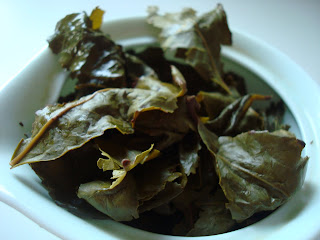
I like Tie Guanyin oolong tea quite a bit; in fact, one of my first experiences with premium Chinese tea was an unforgettable baked TGY that my mentor Donna Fellman shared with me almost nine years ago. That being said, I have always been a little wary of TGY oolong because I seem to have had just as many lackluster experiences as good ones.
The tin.

I decided to use my preschool-level Mandarin skills, a magnifying glass, and a couple of favorite websites (MDGB and NCIKU), to translate all of the Chinese text on the tin (even though I knew it would probably take me a few hours). During my time translating, I thought... "This is so cool. I'm going to learn so many fascinating new things about Tie Guanyin tea!"
Here's what I came up with. (Any of my Chinese-literate followers are invited to correct my translations or offer more details in the comments.)
安溪縣位於福建省的東南部,晉江西溪上游, 北緯 24° 50'〜25° 26',東經 117° 36'〜118° 17',地外南廈(門)漳(州)泉(州)金三角合部,居山而近海,隸屬歷名城泉州市。它東接南安縣,西連華安縣,北鄰永春縣,西南與長縣接壤,西北與漳平 縣交界。東西長 74公里,南北寬 63公里,面積 3057.28平方公里。縣境呈圓形,佮稱“一塊碟”,是泉州市地域最大的縣。
I gather that this is all just highly technical information about the geographical location of Anxi County.
介於綠茶和紅茶之間屬於半發酵茶類.
Semi-fermented [oxidized] tea is between green tea and black tea. (Well duh.)
福建安西勞動人民在清雍正三年至十三年(1725年至1735年)創制發明了青茶,首先傳人閩北後傳人台灣省。
Workers from Fujian province's Anxi county first invented this process between 1725 and 1735 (during Emperor Qing Yongzheng's rule), and they taught it to the "north of Min river" folks who moved to Taiwan.
So that was all it said on the tin!? I felt a little bit like Ralphie in "A Christmas Story" when he finished decoding Little Orphan Annie's secret radio message... and all it said was... "Be sure to drink your Ovaltine."
Anyway... I suppose it's time I got down to business and actually reviewed the tea.
This "1725 Tie Guan Yin" is from the Fujian Horizon Tea Co. Ltd. I could not figure out when the tea was made.
The leaves were packed not only in the lovely and collectible tin pictured above, but also in small single-serving vacuum sealed bags (which is fairly common). What I did not expect to find was another layer of plastic bag inside the first. Now that's a lot of packaging! I wonder if the tea inside will live up to all its packaging... or if this is all just a plot to sell mediocre tea to tourists. I was starting to worry as I opened up the second layer of plastic.
Here's what I found.

I was a little bit disappointed because I was hoping to find a roasted tea and it turned out to be a lightly oxidized TGY. Oh well. I poured the leaves into a large gaiwan and gave the tea a 3 second rinse with boiling water. It had a nice "minty-cheesecake" aroma.
My first two infusions were deemed "not offensive." Perhaps I had brewed them too weak because the broth was pretty dull.
The tea came alive for infusions three, four and five. It yielded a great yellow color with a few little sparkles on the surface. These infusions had peppery pine and mineral notes balanced by a touch of tropical flower aroma. They also had decent body. The sixth and seventh infusions fell flat and at times presented a little bit of bitter tobacco taste.
The third.

The leaves.

I like Tie Guanyin oolong tea quite a bit; in fact, one of my first experiences with premium Chinese tea was an unforgettable baked TGY that my mentor Donna Fellman shared with me almost nine years ago. That being said, I have always been a little wary of TGY oolong because I seem to have had just as many lackluster experiences as good ones.
Thursday, September 9, 2010
A Lingering Note
Last month, while I was researching the meaning of the Chinese word yun (韻), I asked a Mandarin speaking tea-mentor and friend named Rob Bageant, "What is yun and how does it pertain to the taste of tea?" Mr. Bageant provided me with a wealth of great information that I would like to share with you all today.
Here is his answer:
"Yun" 韻 by itself means many cool things. For instance as a verb it can mean to rhyme. As a noun it can mean a musical note. But in the case of tea it means "to linger" or a lingering flavor. Or, if you like a poetic sense, a lingering note. It is usually tied to the throat (喉韻) (Hou Yun). So it is the note that lingers in the throat.
Please realize that even in Taiwan people argue about whether Hui Gan (回甘) (returning sweetness) and Hou Yun (喉韻) are the same thing or not. Some people even say that, due to physiology, there can be no flavor that lingers in the throat. But geeks like that miss the point that, no matter where our sense receptors are, we nonetheless can have a perceived experience of a note or feeling lingering in our throats. It may even seem sweet to us. It reminds me of yoga and qigong. Whether or not anyone can measure qi is beside the point. If you do the practice, you will have an experience that feels like energy flowing. When you can cultivate this experience, health improves. Who cares if the experience is caused by a thing called qi or if the sensation is just the body's way of saying, "That's it, you've got it."
In any case, despite all the expert opinions on the "real" meaning of these tea terms, with the subjectivity of taste, as opposed to the more repeatable experience of vision, true agreement will always be out of reach.
I thought that was such a great reply and I'm grateful that he gave me the thumbs up to share it on my tea blog. Xiexie Rob!
茶 茶 茶
Here is his answer:
"Yun" 韻 by itself means many cool things. For instance as a verb it can mean to rhyme. As a noun it can mean a musical note. But in the case of tea it means "to linger" or a lingering flavor. Or, if you like a poetic sense, a lingering note. It is usually tied to the throat (喉韻) (Hou Yun). So it is the note that lingers in the throat.
Please realize that even in Taiwan people argue about whether Hui Gan (回甘) (returning sweetness) and Hou Yun (喉韻) are the same thing or not. Some people even say that, due to physiology, there can be no flavor that lingers in the throat. But geeks like that miss the point that, no matter where our sense receptors are, we nonetheless can have a perceived experience of a note or feeling lingering in our throats. It may even seem sweet to us. It reminds me of yoga and qigong. Whether or not anyone can measure qi is beside the point. If you do the practice, you will have an experience that feels like energy flowing. When you can cultivate this experience, health improves. Who cares if the experience is caused by a thing called qi or if the sensation is just the body's way of saying, "That's it, you've got it."
In any case, despite all the expert opinions on the "real" meaning of these tea terms, with the subjectivity of taste, as opposed to the more repeatable experience of vision, true agreement will always be out of reach.
茶 茶 茶
I thought that was such a great reply and I'm grateful that he gave me the thumbs up to share it on my tea blog. Xiexie Rob!
Sunday, July 25, 2010
A Message from the Guguan Tourism Board
Guguan (谷關) is a hotspring (溫泉) resort village located in Taichung county, Taiwan (台中縣, 台灣). Every year, this peaceful little town attracts thousands of hotspring-loving tourists from all over the world. But even with all of those visitors, you can still find some pretty posh places to soak your bones without spending a lot of money. In the last five years, I have enjoyed two very relaxing overnight visits to Guguan, and each time I've only spent about US $50 (including all meals and lodging).

The town clings to two sides of a deep ravine that have been stitched together by a few rad suspension bridges. Resort hotels are all over the place. Don't stay at them unless you have a few hundred dollars budgeted... but do hit them up for a good soak. Some resorts, like the Four Seasons Spa Hotel, will open their pools to non-guests for around $10 to $20 depending on the time of year. But if that's still too steep... you can also find some wonderful pools in the $5 range.
I really love the Chinese verb "pao" (泡) meaning "to steep" (as in tea leaves). It is the same word used for soaking one's self in a hotspring. So if you would like to have a dip, just say "wǒ yào pào wēnquán (我要泡溫泉)." Which means: "I would like to steep myself in the hotspring."

The tea scene in Guguan is decent... there are a few little cafes that serve good tea, fresh juice and snacks to the health-conscious visitors. But the best tea in Guguan can be for found for free in the parks and pagodas. If you see some folks sitting in the shade and relaxing with a portable stove and teapot go right up to them and say "nihao" (你好). Tea lovers from any culture love to meet one another, so ask them what type of tea they are drinking and if you can taste a little bit. Chances are they will share a little and you'll spend all afternoon sipping oolong and chatting.

The trails around town are very beautiful and offer some short, rewarding hikes. As you power your way up a flight of stairs to the next scenic look-out you may hear some other hikers yell "jia you" (加油) as they huff and puff. This literally means "add oil" but is often translated as "step on the gas" or "make more of an effort."

In addition to the many beautiful hotsprings and hiking trails around Guguan, the travel map that I picked up for free in the hotspring museum (also free) stated the following: "There are other natural wonders in the Guguan Scenic Area as well--a thousand year old sacred Chinese white pine tree and a Pig of Destiny."
I've got to go back and find that Pig!

The town clings to two sides of a deep ravine that have been stitched together by a few rad suspension bridges. Resort hotels are all over the place. Don't stay at them unless you have a few hundred dollars budgeted... but do hit them up for a good soak. Some resorts, like the Four Seasons Spa Hotel, will open their pools to non-guests for around $10 to $20 depending on the time of year. But if that's still too steep... you can also find some wonderful pools in the $5 range.
I really love the Chinese verb "pao" (泡) meaning "to steep" (as in tea leaves). It is the same word used for soaking one's self in a hotspring. So if you would like to have a dip, just say "wǒ yào pào wēnquán (我要泡溫泉)." Which means: "I would like to steep myself in the hotspring."
Here is one of several pools in which I've soaked:

The tea scene in Guguan is decent... there are a few little cafes that serve good tea, fresh juice and snacks to the health-conscious visitors. But the best tea in Guguan can be for found for free in the parks and pagodas. If you see some folks sitting in the shade and relaxing with a portable stove and teapot go right up to them and say "nihao" (你好). Tea lovers from any culture love to meet one another, so ask them what type of tea they are drinking and if you can taste a little bit. Chances are they will share a little and you'll spend all afternoon sipping oolong and chatting.
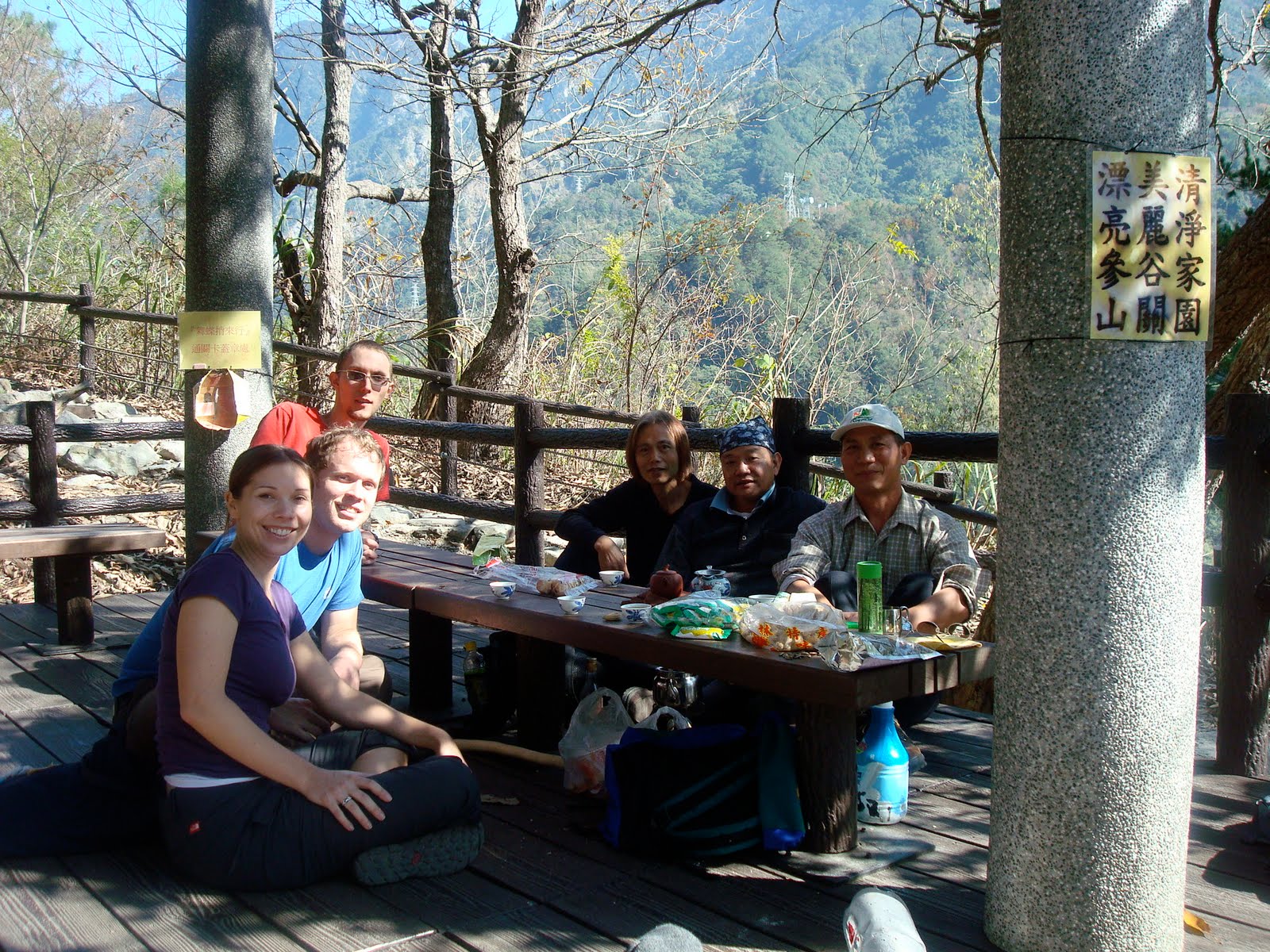
The trails around town are very beautiful and offer some short, rewarding hikes. As you power your way up a flight of stairs to the next scenic look-out you may hear some other hikers yell "jia you" (加油) as they huff and puff. This literally means "add oil" but is often translated as "step on the gas" or "make more of an effort."
Strolling along the Shaolai footpath (捎來步道).

In addition to the many beautiful hotsprings and hiking trails around Guguan, the travel map that I picked up for free in the hotspring museum (also free) stated the following: "There are other natural wonders in the Guguan Scenic Area as well--a thousand year old sacred Chinese white pine tree and a Pig of Destiny."
I've got to go back and find that Pig!
Monday, June 1, 2009
Shu Shu's Mandarin Lesson #6
Ni Hao tea friends. It's your old pal Shu Shu here with another Mandarin Chinese diversion.
Brett has been drinking a lot of wonderful new spring teas lately and I'm very lucky because sometimes he pours a little hot tea on yours truly!

Today's phrases are:
中國和日本的綠茶有什麼不一樣? = What's the difference between Chinese and Japanese green tea?
中國 = zhōngguó = China
和 = hé = and
日本 = rìběn = Japan
的 = de = possessive particle
綠茶 = lùchá = green tea
有 = yǒu = have
什麼 = shénme = what
不 一樣 = bùyīyàng = different (or not the same)
春茶很好香 = Spring tea is very fragrant.
春 = chūn = spring
茶 = chá = tea
很 = hěn = very
好 = hǎo = good
香 = xiāng = fragrant
玫瑰不管叫啥名,聞起來總是香的 = A rose by any other name would smell as sweet.
玫瑰 = méiguī = rose
不管 = bù guǎn = no matter what, regardless
叫 = jiào = called
啥 = shá = what
名 = míng = name
聞起來 = wénqǐlai = smell like
總是 = zǒng shì = always
香 = xiāng = fragrant
的 = de = possessive particle
*cool photo by my buddy James!
Brett has been drinking a lot of wonderful new spring teas lately and I'm very lucky because sometimes he pours a little hot tea on yours truly!
I hope he pours this matcha on me!*

Today's phrases are:
中國和日本的綠茶有什麼不一樣? = What's the difference between Chinese and Japanese green tea?
中國 = zhōngguó = China
和 = hé = and
日本 = rìběn = Japan
的 = de = possessive particle
綠茶 = lùchá = green tea
有 = yǒu = have
什麼 = shénme = what
不 一樣 = bùyīyàng = different (or not the same)
春茶很好香 = Spring tea is very fragrant.
春 = chūn = spring
茶 = chá = tea
很 = hěn = very
好 = hǎo = good
香 = xiāng = fragrant
玫瑰不管叫啥名,聞起來總是香的 = A rose by any other name would smell as sweet.
玫瑰 = méiguī = rose
不管 = bù guǎn = no matter what, regardless
叫 = jiào = called
啥 = shá = what
名 = míng = name
聞起來 = wénqǐlai = smell like
總是 = zǒng shì = always
香 = xiāng = fragrant
的 = de = possessive particle
*cool photo by my buddy James!
Friday, May 1, 2009
Shu Shu's Mandarin Lesson #5
Nihao tea friends! Shushu T. Dragon here with a special video Mandarin lesson! Brett wrote and recorded the folk song, Uncle Ken did the video editing, and I was the handsome dragon model.
We hope you enjoy it!
(You can also view this video on my youtube channel.)
We hope you enjoy it!
(You can also view this video on my youtube channel.)
Wednesday, April 8, 2009
Shu Shu's Mandarin Lesson #4
Hello tea friends. It's me Shu Shu the Chinese tea dragon here to teach you a few new phrases in Mandarin Chinese!

早安老師!

Today's phrases are:
我的生日快到了 = My birthday is fast approaching.
我的 = wǒde = My, mine
生日 = shēngrì = birthday
快 = kuài = fast or quick
到了 = dàole = arriving, arrived
櫻花很好看 = Cherry blossoms are very pretty.
櫻花 = yīnghuā = Cherry blossom, sakura
很 = hěn = very
好看 = hǎokàn = pretty, good looking
我們今天晚上要吃炒麵 = We want to eat chow mein this evening.
我們 = wǒmen = we
今天 = jīntiān = today
晚上 = wǎnshang = evening
要 = yāo = want
吃 = chī = eat
炒麵 = chǎomiàn = stir-fried noodles
我的生日快到了 = My birthday is fast approaching.
我的 = wǒde = My, mine
生日 = shēngrì = birthday
快 = kuài = fast or quick
到了 = dàole = arriving, arrived
櫻花很好看 = Cherry blossoms are very pretty.
櫻花 = yīnghuā = Cherry blossom, sakura
很 = hěn = very
好看 = hǎokàn = pretty, good looking
我們今天晚上要吃炒麵 = We want to eat chow mein this evening.
我們 = wǒmen = we
今天 = jīntiān = today
晚上 = wǎnshang = evening
要 = yāo = want
吃 = chī = eat
炒麵 = chǎomiàn = stir-fried noodles
晚安老師!


Sunday, March 1, 2009
Shu Shu's Mandarin Lesson #3
Hi everybody. It's time for another Mandarin lesson with me Shu Shu the tea dragon!
Today's phrases are:
早安 = Good Morning
早 = zǎo (rhymes with "wow") = morning
安 = ān = peace
你舒服嗎? = Are you comfortable?
你 = nǐ = you
舒服 = shūfu (pronounced "shoe foo") = comfortable
嗎 = ma (pronounced "muh") = this particle makes the sentence a question
謝謝老師 = Thank you teacher
謝謝 = xièxie (sounds kind of like "shayshay") = thank you or thanks
老師 = lǎoshī = (lao rhymes with "wow" and shi sounds like "sure") = teacher

Today's phrases are:
早安 = Good Morning
早 = zǎo (rhymes with "wow") = morning
安 = ān = peace
你舒服嗎? = Are you comfortable?
你 = nǐ = you
舒服 = shūfu (pronounced "shoe foo") = comfortable
嗎 = ma (pronounced "muh") = this particle makes the sentence a question
謝謝老師 = Thank you teacher
謝謝 = xièxie (sounds kind of like "shayshay") = thank you or thanks
老師 = lǎoshī = (lao rhymes with "wow" and shi sounds like "sure") = teacher
Shu Shu says: "I really hope he pours that hot tea on my head!"

Sunday, February 1, 2009
Shu Shu's Mandarin Lesson #2
Nǐhǎo (你好, hello) blog-buddies! It's your favorite little tea dragon "Shu Shu" here. Every month I prepare a few random phrases for you in Mandarin Chinese and Pinyin and then I post them here on my péngyou (朋友, friend) Brett's tea blog.
Today's phrases are:
貅貅是我最喜歡的小茶龍! = Shu Shu is my favorite little tea dragon!
貅貅 = Xiūxiū (That is my name in Chinese. It's pronounced kind of like "Shee-oh Shee-oh)
是 = Shì (pronouced like "sure") = Shì is the Chinese verb "to be." In this case it means "is."
我 = Wǒ (sounds like "woe") = This is the Chinese pronoun for "I or Me."
最喜歡 = Zuì Xǐhuan (Zui sounds kinda like "zoo-eh") (Xi sounds like "she") = favorite
的 = De (pronounced "duh") is a particle. One of its uses is to link an adjective with whatever it's describing and that's what it's doing in this sentance.
小 = Xiǎo = Little
茶 = Chá = Tea
龍 = Lóng = Dragon
他很帥 = He is very handsome.
他 = Tā = This is the Chinese pronoun for "He."
很 = Hěn (An "e" in Pinyin sounds like a "u" so pronounce this like "hun") = Very
帥 = Shuài (Sounds like "Shoe-eye" ran together and said very quickly) = Handsome
* Grammar note. Literally I said "He Very Handsome." The word 是 (Shì)(is) is usually left out of these short descriptive sentences.
梅子我都吃了 = I ate all the plums.
梅子 = Méizi (Mei is pronounced "May") = Plum or Plums
我 = Wǒ (see above) = I
都 = Dōu (sounds like "dough") = All
吃 = Chī (kind of sounds like "chur") = eat
了 = Le (pronounced "luh") = a particle that "completes an action" so in this case it means the "eating is finished" or "I ate them all.")
Today's phrases are:
貅貅是我最喜歡的小茶龍! = Shu Shu is my favorite little tea dragon!
貅貅 = Xiūxiū (That is my name in Chinese. It's pronounced kind of like "Shee-oh Shee-oh)
是 = Shì (pronouced like "sure") = Shì is the Chinese verb "to be." In this case it means "is."
我 = Wǒ (sounds like "woe") = This is the Chinese pronoun for "I or Me."
最喜歡 = Zuì Xǐhuan (Zui sounds kinda like "zoo-eh") (Xi sounds like "she") = favorite
的 = De (pronounced "duh") is a particle. One of its uses is to link an adjective with whatever it's describing and that's what it's doing in this sentance.
小 = Xiǎo = Little
茶 = Chá = Tea
龍 = Lóng = Dragon
他很帥 = He is very handsome.
他 = Tā = This is the Chinese pronoun for "He."
很 = Hěn (An "e" in Pinyin sounds like a "u" so pronounce this like "hun") = Very
帥 = Shuài (Sounds like "Shoe-eye" ran together and said very quickly) = Handsome
* Grammar note. Literally I said "He Very Handsome." The word 是 (Shì)(is) is usually left out of these short descriptive sentences.
梅子我都吃了 = I ate all the plums.
梅子 = Méizi (Mei is pronounced "May") = Plum or Plums
我 = Wǒ (see above) = I
都 = Dōu (sounds like "dough") = All
吃 = Chī (kind of sounds like "chur") = eat
了 = Le (pronounced "luh") = a particle that "completes an action" so in this case it means the "eating is finished" or "I ate them all.")
Thank you Teacher!


Thursday, January 1, 2009
Shu Shu's Mandarin Lesson #1
Happy New Year, B.D.T.B. blog readers! I hope 2009 is a peaceful and productive year for all of us. Do you make New Year's resolutions? I do. This year, my resolution is to practice Mandarin Chinese more often. Now that Shu Shu the dragon has come to live with us I have another friend to practice with! He is a Chinese dragon and speaks Mandarin fluently. If you are interested in learning a little Chinese, look for a new series of posts called "Shu Shu's Mandarin Lessons." Each month he will teach us a few useful phrases! He will give us the Chinese and the meaning followed by the pronunciation and tone in Pinyin.
新年快樂 = Happy New Year
新 Xīn (sounds like "shin") = New
年 Nián (pronounced like nee-an) = Year
快樂 Kuàilè (Kuai rhymes with "buy." Le sounds like "luh") = Happy, Merry
你喜歡我的褲子嗎 = Do you like my pants?
你 Nǐ (sounds like "knee") = You
喜歡 Xǐhuan (Xi sounds like "she") = Like
我的 Wǒde (Wo sounds like "woe." De sounds like "duh") = My, Mine
褲子 Kùzi (Ku sounds like "coo." Zi sounds like "zuh") = Pants, Trousers
嗎 (?) Ma = Question particle. It turns statements into questions.
貓咪在哪裡 = Where is kitty?
貓咪 Māomī (pronounced like "mow mee") = Kitty
在 Zài (rhymes with "spy") = At, Located
哪裡 Nǎlǐ (pronounced like "nah lee") = Where?

新年快樂 = Happy New Year
新 Xīn (sounds like "shin") = New
年 Nián (pronounced like nee-an) = Year
快樂 Kuàilè (Kuai rhymes with "buy." Le sounds like "luh") = Happy, Merry
你喜歡我的褲子嗎 = Do you like my pants?
你 Nǐ (sounds like "knee") = You
喜歡 Xǐhuan (Xi sounds like "she") = Like
我的 Wǒde (Wo sounds like "woe." De sounds like "duh") = My, Mine
褲子 Kùzi (Ku sounds like "coo." Zi sounds like "zuh") = Pants, Trousers
嗎 (?) Ma = Question particle. It turns statements into questions.
貓咪在哪裡 = Where is kitty?
貓咪 Māomī (pronounced like "mow mee") = Kitty
在 Zài (rhymes with "spy") = At, Located
哪裡 Nǎlǐ (pronounced like "nah lee") = Where?
Thank you Teacher!

Subscribe to:
Posts (Atom)


 Posts
Posts

