Showing posts with label lishan. Show all posts

Friday, April 12, 2013

New Taiwanese Tea at Phoenix Tea

Lately we have been in Taiwanese tea heaven at Cinnabar's and my tea shop Phoenix Tea. Please allow me to take you on a little tour of my current favorites.

Shan Lin Xi Long Feng Xia (杉林溪龍鳳峽) - This winter oolong is very complex. It blends wild herbaceous tasting notes such as cedar, pine, and rosemary with clean winter snow and dynamic floral bouquets. A pleasant long-lasting tingly sensation lingers in the back of my throat after a long session with this fine tea.


High Mountain Jin Xuan (高山金萱) - This winter tea uses the golden lily cultivar and produces a luscious, sweet and buttery cup of oolong tea. It is floral with little hints of popcorn. The broth is very smooth and substantial.


Lishan (梨山) - This winter Lishan is beyond compare. We've already restocked it once because so many tea lovers have fallen for its charms. Tasting notes of sugarcane and crisp tart fruits are balanced with buttery, wild honeysuckle aromas. The sweetness lingers for hours.


Dong Fang Mei Ren (東方美人) -  This Pinglin (坪林) grown Dong Fang Mei Ren may taste a little lighter, brisker and smoother to you if you're more used to drinking Hsinchu grown Dong Fang Mei Ren. I think this tea is incredible and balanced with big honey and ripe peach notes in most infusions. It has a long-lasting sweet, brisk aftertaste.


Meishan Hongcha (梅山紅茶) - This fully oxidized high mountain tea is flat out amazing. It blends brisk and malty classic black tea flavors with alluring aromas like rose and cocoa.


Jin Xuan Hong Cha (金萱紅茶) - A heavily oxidized tea that expertly combines all the goodness of a black tea, gently roasted oolong, and a buttery caramel. The resulting delicious-ness has made this tea very popular among many of our in store customers.


Thursday, January 13, 2011

Floating Leaves' Winter 2010 Lishan

Last week I treated myself to a belated Christmas gift. I bought a couple ounces each of Floating Leaves' new Winter 2010 Lishan High Mountain Oolong (梨山高山烏龍) and Winter 2010 Honorable Mention Wenshan Baozhong (文山包種). This was the first time I'd purchased some tea just for myself in a very long time. Today I'm going to review the Lishan.

I covered the bottom of a small gaiwan with dry leaf and then whipped it up into a "tea cyclone" with boiling hot water. I did not rinse the leaves. After about 50 seconds I decanted my first infusion.

the first infusion


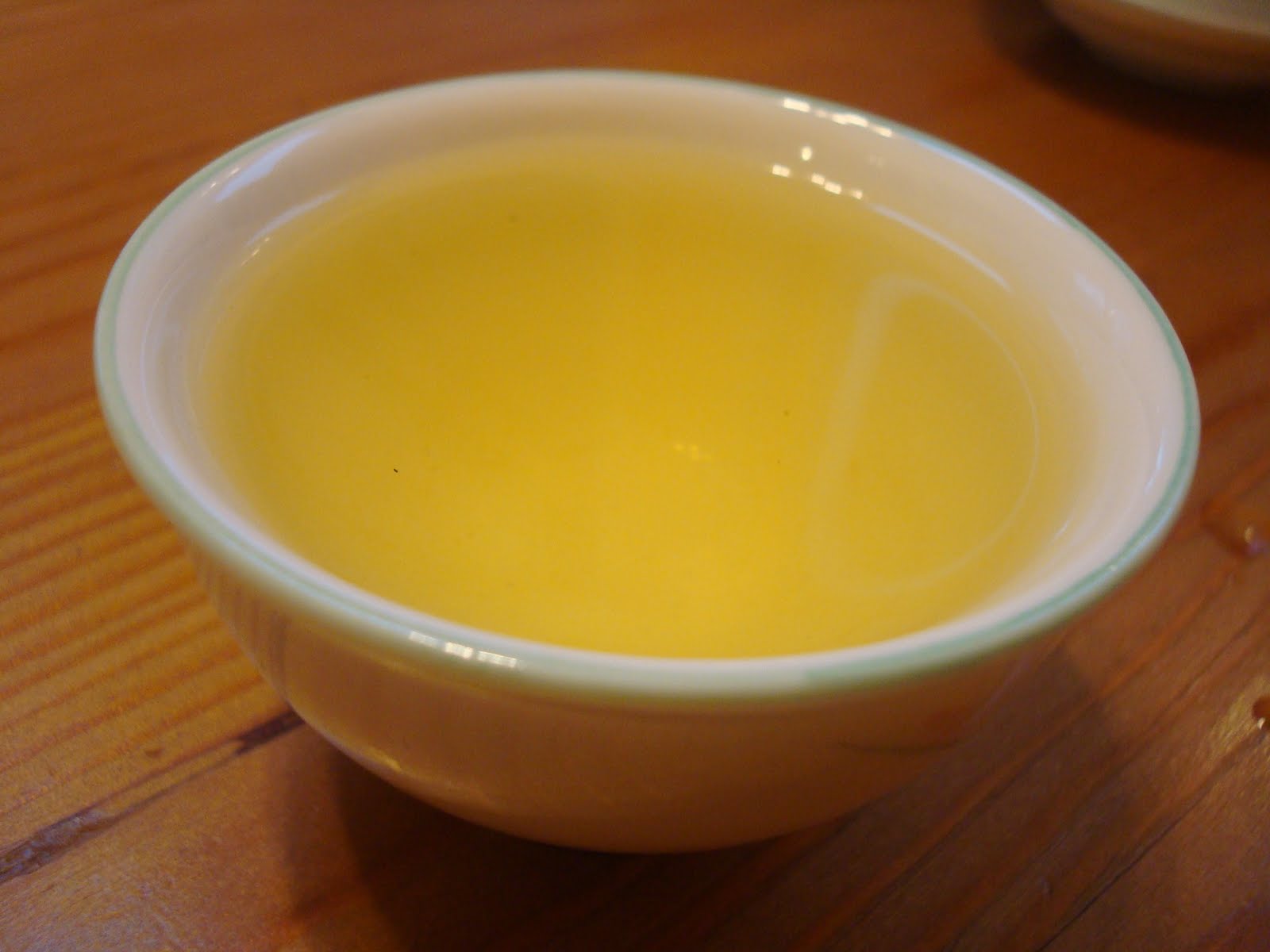
The liquor poured thick and yellow with a delicate floral aroma. My mouth began to water. I haven't had great high mountain oolong in over 6 months.

the third infusion


I really love this tea and I feel like its price ($15 per ounce) is just fantastic for its level of quality in the current North American retail market for seasonal Taiwanese oolong.

My tasting notes during the first 6 infusions included: sugarcane, crisp tart pear, nectar, substantial broth, delicate sulfur aroma, buttery, honeysuckle, and dandelion. My notes for the final two infusions were: thinner broth with delicate pine and rosemary notes.

the spent leaves


The aftertaste lingered all day and I am now one happy oolong drinker. Thanks Shiuwen!

Wednesday, March 24, 2010

Shu Shu and Brett at Lishan

Nihao Tea Friends! Here is a short (and dorky) video of Shu Shu and I enjoying the view from a little hilltop pagoda near Lishan, Taiwan (梨山,台灣).


I hope you found the terrible sound and shaky camera work to be more cute than annoying :)

Friday, March 19, 2010

"Winging it" in Nanshan

On January 18th, 2010, I took a cab from Yilan (宜蘭) to Lishan (梨山). You may be asking yourself what the heck was I thinking taking an uncharacteristically extravagant cab ride instead of an inexpensive bus ride. That's a great question... and the answer is a long, boring, somewhat frustrating travel story that I'm not going to get into right now...

... so anyway... I took a cab from Yilan to Lishan. My cab driver was a great guy and a very safe driver. We picked up his wife to join us on the long trip and we all chatted in Mandarin as we ascended the mountain. When super-thick fog rolled in at sunset, our visibility on the narrow broken highway seemed to drop to only a few feet! My driver drove like a champ. He was slow and careful, and even stuck his head out the window at times to help him see the road.

Halfway to Lishan, we stopped at a grimy grocery store alongside the highway in Nanshan (南山). Nanshan is a sleepy little cabbage town somewhere between Yilan and Lishan and my guess is that nobody ever stops here unless they grow cabbage, need gas, or have to go pee. We were in the latter camp.

My driver asked if I'd like some tea. I enthusiastically said yes because I had only had a Lara bar and a bottle of ready-to-drink oolong since breakfast. My driver pulled a nearly-empty bag of Lishan high mountain oolong from the trunk of his taxi, and asked the folks at the store if they had a teapot that we could use. Unfortunately they did not.

It's tea time in Nanshan Baby!


My driver seemed a little annoyed and muttered to himself, "who around here doesn't have a teapot?" He concluded that we would just have to "wing it," so he grabbed a couple of grubby beer glasses and a plastic lid. He brewed the tea in one cup and then poured it into the other (no easy task because a lot of tea dribbled down the side of the cup). Because we only had two beer glasses, he and his wife shared a disposable plastic cup. I guess they wanted me to have the other glass cup because I was their guest and the Taiwanese are always such sweet and thoughtful hosts.

My driver's wife bought me some five-spice eggs without asking me first so I had to politely explain that I did not eat eggs. She did not seem to mind and insisted on buying me a vegetarian bun instead. I tried to protest her hospitality but of course it didn't work. I was happy to eat my bun and they ate all the five-spice eggs.

The tea is steeping.
(I love how he put a bit of half eaten egg on top to keep the lid from blowing off.)


We had a good time drinking our tea and chatting with several of the chain-smoking, betel nut-chewing patrons of the little store. They were all totally blown away to see a tea-crazed white boy drinking their delicious local tea from a beer glass while on his way up to Lishan!

Cheers!


With our spirits renewed, and the fog starting to lift, we drove the remaining two hours to Lishan. Unfortunately, the higher we went the more broken the highway became. While the driver focused on keeping the car from falling off the mountain, his wife and I focused on not throwing up. Having the advantage of sitting shotgun, I succeeded. His wife, in the backseat, was not as lucky. Needless to say, we all became a little stressed-out during this leg of the journey. I really didn't envy my new friends who planned to drive home to Yilan that evening, so after we arrived, I happily insisted on paying my driver more than the already negotiated, and already quite expensive (don't ask me how much) price.

It certainly wasn't the best day I've ever had in Taiwan, but thanks to some great people, it was still a pretty good one. I was so happy to have reached my goal and to have had some rewarding and memorable experiences along the way!

Friday, January 29, 2010

Lishan Ming Gang Tea Garden

One of the highlights of my most recent Taiwan trip was tasting tea with the proprietress of Lishan's Ming Gang Tea Garden (梨山明岡茶園). In my opinion, this little garden, about 3 kilometers outside of Lishan town, produced some amazing tea in November 2009. I bought only three jin (mainly because I didn't bring enough cash up to Lishan and there were no ATMs that took foreign cards).


Of course I really love all of the high mountain oolong teas that I chose to import during this month's buying and learning trip... but my two personal favorites were this Da Yu Ling and this Lishan.

For today's review I used my small gaiwan (100 ml) with about 5 grams of dry leaf. I steeped it many times using boiling water. In between the later steeps I played with the beautiful limp leaves. I recorded the following tasting notes during this session: fruity (mostly peach and pear), rosy, sulfur (as in natural hotsprings), buttery, and mineral.

Sunday, January 24, 2010

10 things I learned at Lishan

1. Lishan (梨山) (pear mountain), in Taiwan's Taichung* county (台中縣), is not easy to reach. Highway 8 is closed for repairs between Ching Shan (青山) just east of Guguan (谷關) and Deji (德基) just west of Lishan. Only a couple of daily buses are available from Yilan (宜蘭) or one from Taichung (台中) and they take many hours because the roads are narrow and broken. Check out my friend Josh's blog post for a couple photos of the highway.

at the intersection of highways 7 and 8 near Lishan

2. Once you make it up to Lishan it is kind of hard to get around. There are no regular cabs or buses around Lishan, but I was able to walk and hitchhike to a few nearby tea farms. I wanted to go to He Huan Shan (合歡山) but I decided to stay within 5 kilometers of town. I'll have to come back someday with my own car or scooter.

3. There is not a lot of tea being grown within 5 kilometers of Lishan town. I went to Fushoushan
farm (福壽山農場) and did find a handful of other tea farms during my alpine hikes but for the most part I'd say Lishan is surrounded by fruit, fruit, fruit, cabbages, and fruit. I probably found only one tea garden for every twenty orchards!


4. With an elevation of around 1900 to 2200 meters, Lishan and the surrounding area can get really cold. I was lucky to have brought enough layers but I was shivering in the morning as I hiked along the frosty trails. The afternoon sun was glorious but it faded quickly.

icy!

5. Mid-January is not a great time to hunt for high mountain tea up in Lishan. According to my new friends at the Ming Gang Tea Garden (明岡茶園), Lishan has only three production seasons per year, which they described as: Spring Tea (春茶) around May, Second Season Tea (二季茶) around August, and Winter Tea (冬茶) around October or November. By mid-December most of the good tea has already been bought up.

healthy Lishan tea bushes on January 19, 2010

6. Lishan tea is expensive. I learned this from all of the working class people I hung out with up on the mountain. When I told them that I loved Lishan's high mountain tea and that it is what had inspired me to visit their part of the world, most would reply "the tea up here is too expensive... one jin (600 grams) usually costs between 3000 and 6000 NT$!" Maybe I'd have had better luck if I'd been there during actual tea production but my mid-January explorations only served to confirm their rants.

7. The folks at the town's visitor center are so kind and welcoming and they will even hook you up with some amazing tea to sip while you chat.

one cup of love poured from a steel thermos
into this cute little mug


me and my visitor-center homies


8. Besides tea and fruit, Lishan has a lot of other cool stuff to see. Such as...

... a scenic pagoda ...

... a talented painting tire man ...

... and a lovely temple ...


9. Lishan's fruit lives up to the hype! I had a few big, plump, juicy asian pears and a gooey, sweet tomato-passionfruit from the fruit vendors around Lishan and Fushoushan farm.

roadside fruit vendors

10. Lishan is absolutely gorgeous. I'm so glad I made it up to this beautiful alpine area. I greatly enjoyed my windy, sunny hikes among the pear orchards and seeing the many dramatic (sometimes snowy) peaks that surrounded this welcoming little town. I look forward to going back (but I may wait until the highway is fixed).


*I usually use the Pinyin system to spell Chinese words, but for this post I used the Taiwanese spellings when they differed.