Step 1 - Find some clean fresh water. Those of us who live in urban areas will often find it lurking in faucets or hoses, while rural water usually hides out in lakes, rivers and glaciers. Should you happen to live in a very dry place you may need to use a dowsing rod.
Exhibit A - Fresh water in its natural habitat.

Exhibit B - An average everyday elephant head faucet.


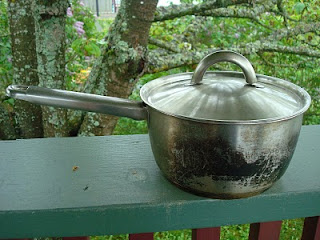
Step 2 - Pour the water into a heating vessel. A stove-top kettle or an electric kettle is preferred, but a metal cooking pan (MCP) will work in a pinch.
Exhibit C - One totally awesome tea kettle!

Exhibit D - Your typical MCP

Step 3 - If you're using a stove-top kettle or a MCP, put it on a burner and turn the heat to its highest setting. If you are using an electric kettle, follow the manufacturer's recommendations for turning it on (usually there is some sort of switch manipulation involved).
WARNING: Do not let your out-of-town guests accidentally put your electric kettle on a hot stove-top burner as this will result in melting plastic and toxic fumes which are generally considered bad for tea making.
Exhibit E - NOOOOO ! ! ! !


Step 4 - Wait. In my opinion, this is the easiest of the five steps. You can use this down time to catch up on some other tea making steps, use the bathroom, or just zone out. Feel free to watch the pot if you want to, because numerous experiments have proven that, contrary to some household myths, "pot watching" does not effect boiling.
Step 5 - Turn the heat off when the water starts boiling. Some kettles will whistle when this happens, but if yours does not, or if you are using a MCP, the vessel will also shake, rattle and produce lots of steam. The water inside it will look hot and bubbly. All of these are good signs that your water is now boiling! Electric kettles, on the other hand, will turn themselves off when they have reached boiling. That moment is often accompanied by a satisfying little "click" sound.
Exhibit F - Mission Accomplished!


 Posts
Posts

